
Nicole Gipson – ECR Spotlight
In our ECR Spotlight Series for 2023, Dr. Nicole Gipson traces the marginalisation of Black single female-headed households and outlines a theory of what she terms as ‘dependency talk.’ This piece follows the Academic Writing for the Public workshop that GENDER.ED conducts annually.
Dependency Talk: Needs Discourse and The Public Housing Crisis in New York City
By Dr. Nicole M. Gipson
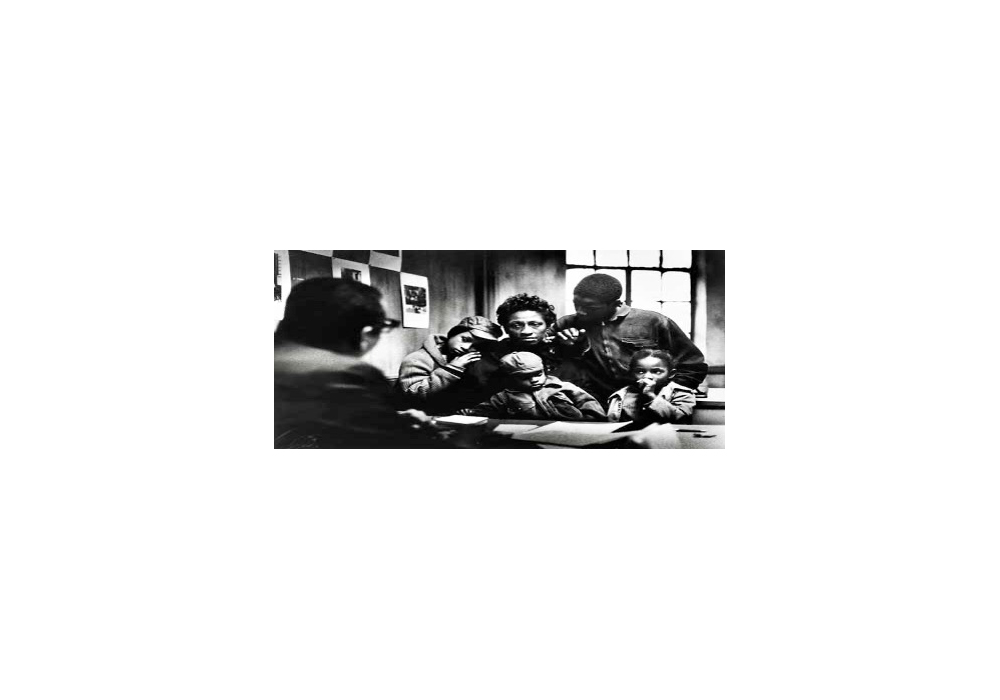
Poor Black single female-headed households (FHHs) have always lived on the edge of things, labeled as victims of the “disease” known as welfare dependency. However, this marginalization and pathologization occurred over several decades of increasingly racialized and gendered spaces that left no room for the traditional Black family. The Fontenelle Family (pictured below), who became the face of poverty in the late 1960s was actually headed by a British West Indies immigrant, Norman Fontenelle, Sr. Indeed, between 1890 to 1950, Black women had higher marriage rates than white women and only 9% of Black children lived in homes with fatherless heads of household, a norm that persisted until the mid-1960s when Black fatherlessness skyrocketed. The decade of the 1970s saw a 62% increase in Black FHHS in poverty. This “feminization” and racialization of poverty had a profound impact on housing outcomes for families living in urban spaces across America.[1]
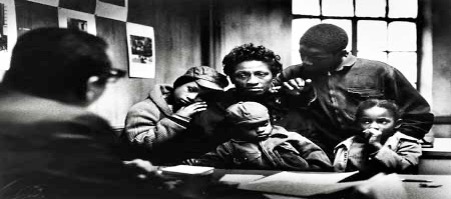
The Welfare Office The Fontenelle family, Harlem, NY. 1967. Artist, Gordon Parks
During the 1970s, state housing policy for low-income families in American urban spaces was largely shaped by how Black FHHS were portrayed by the media; evaluated by local constituencies; and politicized by federal, state, and local representatives. For example, it is during this period that we begin to see the term “welfare queen” used in the media coverage of a politician eager to spin rare instances of welfare abuse into a rampant practice of welfare fraud. This tactic was used by a rising gubernatorial candidate in California – Ronald Reagan – who would later preside over a two-term presidential mandate (1981 -1989) that saw a budgetary retrenchment and reallocations that increased poverty.[2] For working FHHs receiving Aid to Families with Dependent Children (AFDC), this shift would result in a “20 to 30% decline in monthly income.”[3] In Killing the Black Body: Race Reproduction and the Meaning of Liberty Dorothy Roberts argues:
As AFDC became increasingly associated with Black mothers already stereotyped as lazy, irresponsible and overly fertile, [public assistance programs] became increasingly burdened with behavior modification rules, work requirements and reduced effective benefit levels.[4]
A significant mechanism which ensured control over the narrative of how single FHHs, in particular, were defined and assisted, was through the discursive act of dependency talk. I define dependency talk as the use of pejorative, euphemistic language and/or tropes as a means to assert social control over non-traditional families collecting welfare benefits, living in public housing or on waiting lists for housing benefits. Dependency talk belongs to the lexical canon of how the poor have been discussed throughout history in “sin talk”, “sick talk”, and “system talk.” In an effort to tackle long-awaited welfare reform, dependency talk, laid the groundwork for a battle over traditional family values that did not recognize the needs of Black FHHs. Bipartisan bickering which used the “deserving and undeserving” poor alike as political footballs, created legislative logjams and financial shortfalls in federal and state housing assistance programs. This absence of adequate public housing assistance legislation fueled an imminent homeless crisis, particularly for the fastest-growing subpopulation of the homeless – poor urban families. In New York City, officials resorted to increasingly desperate measures for alternative housing solutions, exacerbating the use of welfare hotels as a palliative solution for a growing public housing crisis. Carol Kennedy, mother of 4, spoke about her 16-month stay in the Regent Hotel, a notorious, rundown welfare hotel in Manhattan. “Coming in here I felt I’d lost everything. But I had to be strong for my kids.”[5] Ms Kennedy’s predicament is representative of a major policy shift in America’s approach to the eradication of poverty.
The end of President Lyndon Johnson’s Great Society programs began at its very inception. While the combination ofpublic housing, community action, job training, and law enforcement programs would eventually lead to the modern carceral state, the Johnson administration’s simultaneous launch of anti-crime and antipoverty programs created in low-income neighborhoods set the scene for an unrelenting war on crime. By the 1970s, the war on poverty had become unfashionable, supplanted by the priority of anticrime policies in the Nixon and Ford administrations. Consequently, the poverty war’s demise didn’t occur in one watershed moment but throughout the deployment of its programs. These anti-poverty programs suffered an erosion of the one essential component that extended over all three administrations and defined the lifespan and potency of its federal programs and civil rights legislation – the political will to assist the poor.[6]
Richard Nixon’s Family Assistance Plan (FAP), a controversial proposal (August 1969) that called for a drastic alteration in the nation’s welfare system, including a workfare or job training requirement for mothers with children over three years of age, was denounced as deficient and retrograde. Should women with young children, the very young, the elderly, and the debilitatingly ill be forced to work for substandard wages or enroll in job training? While the Johnson administration’s anti-poverty programs sought to extricate these fragile populations from this impossible choice, the subsequent Nixon administration pushed its workfare agenda as a cure for dependency, regardless of labor market realities, domestic needs, and the employability of these candidates for the workforce. Due to the Nixon administration’s inability to recognize the needs of FHHs, this marginalized community was even more ill-equipped to manage and was not shielded from the vicissitudes of the country’s economic and social challenges. Issues such as under and unemployment, federal, state, and local government fiscal crises, gradual erosion of the welfare state, the diminishing quantity of affordable housing initiatives, and growing waiting list for public housing were only some of the factors that contributed to the exacerbation of the family homeless crisis, particularly for its fastest rising subpopulations – African American single FHHs. In lieu of its own economic difficulties and housing crisis, the New York City Housing Authority, the country’s largest state public housing authority, resorted to the use of hotels to house its burgeoning homeless population.
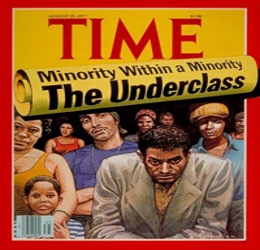
Time Magazine August 29, 1977
Hotels have always been a means of supplementing public housing assistance for relief recipientsas early as 1935, the same year that the first federal public housing project was built in Atlanta, Georgia. However, it wasn’t until 1970 that the term welfare hotel became common practice. Why? Welfare reform was a hot-button issue at the beginning of the Nixon administration. Welfare queens, the underclass, single FHHs, and the inner city where they stereotypically lived, were integral parts of the dependency talk that shaped the welfare debate and stigmatized homeless families. Due to press coverage of New York Representative Edward I Koch’s attack on the Lindsay administration for its use of hotels for approximately 1,000 welfare families, the term welfare hotels became a notorious epithet of this political battle and eventually, a permanent feature of local needs talk. The very existence of welfare hotels was synonymous with the failure of public policy on a federal, state, and local level. Journalists exposed city officials’ reluctance to rely on permanent housing with its $200-a-month spending cap judged as too low for the market. Yet according to federal and state law, welfare hotels, considered emergency housing, had no rent ceiling or spending cap. This lack of restriction was a profitable situation for hotel owners, a financial drain on the state budget, and a poverty trap for renters. Despite their exorbitant fees, New York City’s welfare hotels were notorious for their dilapidated and environmentally dangerous conditions, truant children, and crime-ridden environs. Koch would eventually lose his fight against the use of welfare hotels, which by the time he became mayor of New York City in 1978, had become an integral part of the city’s housing solution for homeless families receiving benefits. Meanwhile, a deepening homeless crisis was metastasizing into a permanent fixture of the American landscape.
Author Bio
Dr. Nicole M. Gipson is a Senior Research Associate at the University of Bristol. She is currently working on the Welfare Citizenship and Intersectional Feminism Project. She is a Franco African American historian specializing in Poverty Studies, African American History, African Diaspora Studies, and Gender Studies. Her interests are in the intersectionality of race, gender, & class in social policy and housing insecurity, as well as transnational feminisms and postcolonial and decolonial theory.
References
[1] Diana M. Pearce, “The Feminization of Ghetto Poverty.” Society 21, no. 1 (1983), 70.; see also: Alain Marcoux, “The feminization of poverty: claims, facts, and data needs.” Population and development review (1998): 131-139.
[2] “‘Welfare Queen’ Becomes Issue in Reagan Campaign: Hitting a Nerve Now 4 Aliases Items in Notebook,” New York Times, Feb. 15, 1976, 51.; see also: Ange-Marie Hancock. The Politics of Disgust the Public Identity of the Welfare Queen / Ange-Marie Hancock. New York: New York University Press, 2004.; Sheldon Danziger, and Robert Haveman. “The Reagan Administration’s Budget Cuts: Their Impact on the Poor,” Focus (Madison, Wis.) 5, no. 2 (1981): 14.
[3] Danziger, Sheldon, and Robert Haveman, “The Reagan Administration’s Budget Cuts: Their Impact on the Poor.” Focus (Madison, Wis.) 5, no. 2 (1981): 14.
[4] Dorothy Roberts, Killing the Black Body: Race, Reproduction, and the Meaning of Liberty. Vintage, 2014, 207.
[5] Jeannie Ralston and Ann Hollister, “No Relief: Grappling with Welfare,” Life Magazine Special Issue: The Dream Then and Now 11, no. 5, Spring 1988: 80.
[6] Alice O’Connor, Poverty Knowledge: Social Science, Social Policy, and the Poor in Twentieth-Century U.S. History. Princeton: Princeton University Press, 2001. https://doi.org/10.1515/9781400824748