
Sisterhood* in the Ghorba
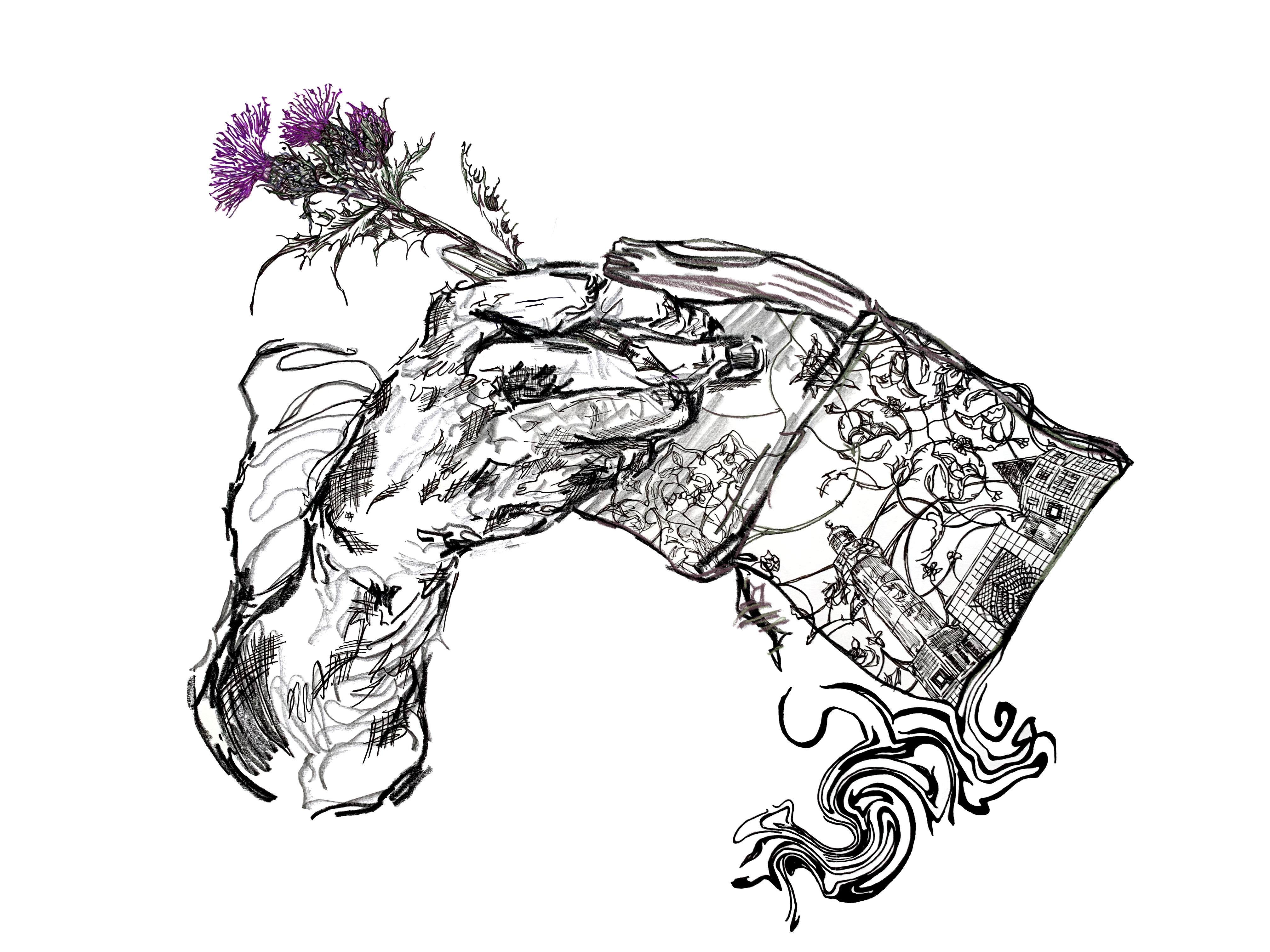
Artist: Lejla Dendić (2023)
For Islamophobia Awareness Month, Mouna Chatt revisits her journals of the past year to reflect on sisterhood*, estrangement, and anti-Muslim racism.
Over the past year, I have found myself forced to reflect on why our elders often refer to Europe as bled el ghorba – land(s) of strangeness, foreignness, or estrangement. The Arabic word ‘ghorba’ refers to a feeling of longing for a place of familiarity. Despite being born and raised in Europe, this feeling of estrangement and longing has been particularly present the past year. In contrast to our elders, however, I think this longing is not so much for the ‘homeland’ or a land far away, but for lands less exploitative, extractive, and violent.
Just this past year, we have borne witness to the dehumanization of Palestinians to the extent that “UN Special Committee finds Israel’s warfare methods in Gaza consistent with genocide.” In the summer, we saw violent riots targeting Muslims, other racialized communities, and mosques in England and Northern Ireland. Between October 7th of 2023 and February 7th of 2024, the organization Tell MAMA recorded “2,010 Islamophobic incidents, predominantly targeting Muslim women and on social media platforms, a stark increase from 600 incidents during the same period the previous year.” Palestine activists and climate change protestors raise concerns they are being criminalized in the UK. The list goes on. And yet, things appear as though they are business-as-usual.
To process my feelings about all of this, I have silently been scribbling my thoughts on paper, letting the ink adorn the blank pages of my (many) journals. As I flick through this past year’s journals to write this blog post, I realize I have scribbled what resembles the Muslim woman’s guide to staying sane in times of insanity.
Thus, for Islamophobia Awareness Month, I’ve decided I don’t want to focus on any more statistics to prove that anti-Muslim racism exists. The past year’s events should be enough proof. Instead, I want to take this opportunity to pay homage to the sisterhood(s)* that helped ground me this past year.
On Sisterhood*:
What is inherent to the ghorba is a sense of ‘antirelationality.’ In a discussion of Ruth Wilson Gilmore’s conceptualization of racial capitalism, Jodi Melamed defines ‘antirelationality’ as “a technology for reducing collective life to the relations that sustain neoliberal democratic capitalism.” Estrangement or tagharoub then, includes a process of severing human ties and connections that don’t serve capitalist purposes, hence the feeling of alienation. It atomizes individuals and breaks collective life, making it harder to stand in solidarity with one another.
I have learnt that sisterhood* - both Muslim and otherwise – is a space to resist this form of ‘antirelationality.’ By creating spaces to feel anger, be vulnerable, share laughter, cherish cultural and spiritual identities, validate each other’s experiences, and depend on one another for mutual care and assistance, sisterhood* rejects connections only for the benefit of capital.
However, neoliberalism’s atomization of individuals has made it difficult for us to accept our needs to relate through sisterhood.* Like anyone else, I really struggle to relate. I am used to dealing with my battles in silence, sweeping them under a rug, and moving on, just as we have been taught time and again.
But last week, I made the conscious decision to sever this practice and share my sadness with my sisters*, and apparently, now, also on this blog. I was recently advised that if I want to succeed as a racialized and Muslim woman, I should probably avoid researching ‘Muslim migrants,’ but study more ‘trendy’ diasporic communities, instead. This singular statement reaffirmed the extent to which Muslims have been vilified, highlighting that even ‘researching’ us has become a problem.
Sharing this statement with fellow Muslim sisters and allowing ourselves to first feel angered by it together and then laugh at it, not only took a burden off my shoulders. It also awarded me with a rejuvenated energy to work in collective with my sisters*. After all, Audre Lorde reminds us that our anger “births change” and can be “expressed and translated into action in the service of our vision and our future.”
At the Black Woman Writer and the Diaspora Conference in 1985, Audre Lorde gave a keynote speech titled “Sisterhood and Survival” that I have found myself returning a lot to recently. To wrap up this blog, I want to leave with you a quote from the speech that left a particularly lasting impression on me:
I would like to say a few words of what sisterhood and survival mean to me. For myself personally, survival means working for the future, and if I am to use all of my self power in the service of what I believe – that all people across the earth must be free – then I must also identify that self and the sources from which that power springs.
Author bio: Mouna Chatt is GENDER.ED's current Undergraduate Communications and Events Intern. She studies Sociology and Politics and is particularly interested in the intersection between gendered hostile immigration politics and public housing policies in the Nordics. More importantly, she is a Fairuz and Raï enthusiast.