
Stitched stories: The Monument Quilt’s Powerful Message on Gender Violence
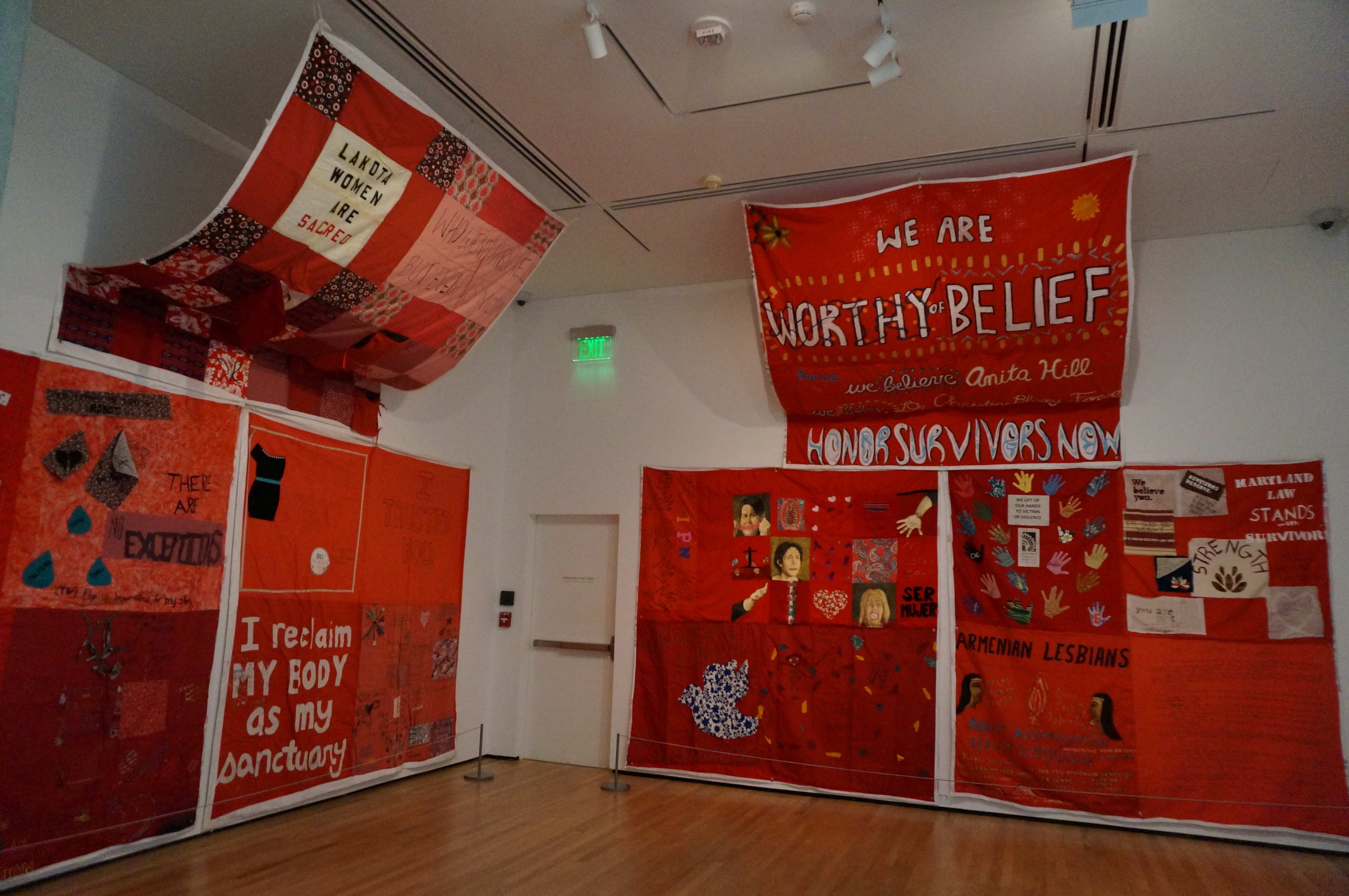
Each square of The Monument Quilt carries a story of survival, solidarity, and healing.
Image credit: Dr. Harriet Gray
The Monument Quilt is a public art project made of 3,000 stitched squares, sharing stories of survivors and allies to raise awareness about gender-based violence. Displayed across the U.S. and Mexico, it transforms public spaces into sites of healing and remembrance.
Stay strong together
The Monument Quilt #1998
How can you voice difficult experiences of gender-based violence in a world that does not hear them? How do you express something that words cannot fully articulate? How can the political act of caring become public? For the thousands of participants on the Monument Quilt, the answer was fabric, thread, and artistic creation. This is a Baltimore based project from FORCE: Upsetting Rape Culture – a collective dedicated to ending sexual violence and promoting consent through the use of public art. The quilt in question is made from 3,000 squares created by survivors of violence and their allies, who all painted, wrote and stitched on the fabric. This collection started in 2013 and was displayed in 33 cities, mostly in the United States, but also some in Mexico. It has been shown 50 times all over both countries. However, the main display happened in 2019 in Washington, where people could see the quilt fully complete.
During May 2024, I undertook a small-scale study funded by the US Embassy and the Peace Lab at the University of York, supervised by Dr. Harriet Gray regarding the Monument Quilt, which feeds into Dr. Gray’s broader study on the memorialization of gender-based violence in contemporary United States. I sampled about 10% of the squares (about 300) and coded different elements of the quilt, including the messages, design features, and themes. Throughout my participation in this study, I found that the quilt served not only as an output for the emotions and experiences of survivors of gender-based violence, but also as a space for feminist care, understood here as a component of social justice.
The purpose of the Monument Quilt was to take up public spaces to heal and raise awareness about sexual and other types of violence. According to FORCE, over 50,000 people saw the quilt in person at the National Mall display, and hundreds of thousands did so online. By transforming public spaces into sites of healing, the quilt encourages a collective response to trauma, which then becomes a communal act of care.
The personal style imprinted on the Monument Quilt by the many people who joined is an important part of the project, and as one goes through the different squares, it is impossible to not notice the different ways people decided to participate. Most of the squares were done over red fabric, but some were done with other colours on top of the red as well. There are different colours of squares on top of the red, as well as different fabrics that were maybe brought with the participants, such as some with flowered patterns, or one done on apparently a pillowcase (#434), which can imply many stories for the viewer, since this square is talking about rape. Perhaps it was the pillowcase that the victim was using when the crime was committed? The materials of the quilt itself can evoke different emotions in us, the viewer.
There are a variety of other ways the participants expressed themselves on the quilt. Some people used words with a very straightforward messages (#2979), and others decided to transmit their ideas only through drawings (#2821). Most of them were done in English (#509), but others were done in other languages (#2787). Some are ambiguous on their message (#2892). A lot of them look like it took a long time to make and that it was very important for the person (#2243). Overall, the quilt is beautiful because of its variety and the care put into it by survivors and allies, which is noticeable in each and every square.
Regarding the themes that were present, we see recurrent messages of caring for other survivors, and words of affirmation for themselves (#585, #1904, #2835, #490, #1520). There were messages of anger and sadness (#3254, #2956, #3091, #230). We also see confusion and shame (#474, #2998, #1531). The quilt helped survivors express their feelings in a safe and artistic space, which might not have been the case elsewhere, as noted by Martin and Gray (2024). Others spoke about consent (#2157, #3028), and silence (#147, #3287, #1670). Intersectionality was also very present on the quilt, as several squares spoke about the specific violences that native women and black women face (#2788, #829, #1766).
Artistic projects such as this can give us important insights into survivors' feelings, but they also contribute to the viewers’ own healing. The quilt serves as a testament to the power of artistic expression as a form of care, and the communal aspect of creating the quilt highlights the relational nature of care, where each participant’s contribution is valued and seen as part of a collective healing journey. The quilt is not just a memorial; it is a call to action for supporting survivors, a symbol of our solidarity towards each other, and a reminder that we can only change when we listen to the voices of survivors. Viewers become part of a larger conversation that emphasizes the importance of care, connection, community and healing.
Author Bio:
Deborah is a Mexican anthropologist with a degree from the National Autonomous University of Mexico and a master's from the University of York. Her work has focused on gender, LGBTQ+ issues, and migration, combining research and advocacy. She has collaborated with vulnerable communities both in Mexico and internationally. Currently, she works in a sustainability team at an international company, applying her expertise to social impact and environmental justice initiatives.
Social media: https://www.linkedin.com/in/deborah-faudoa/