
Being a Mehmaan: Ethnographic Fieldwork and Belonging
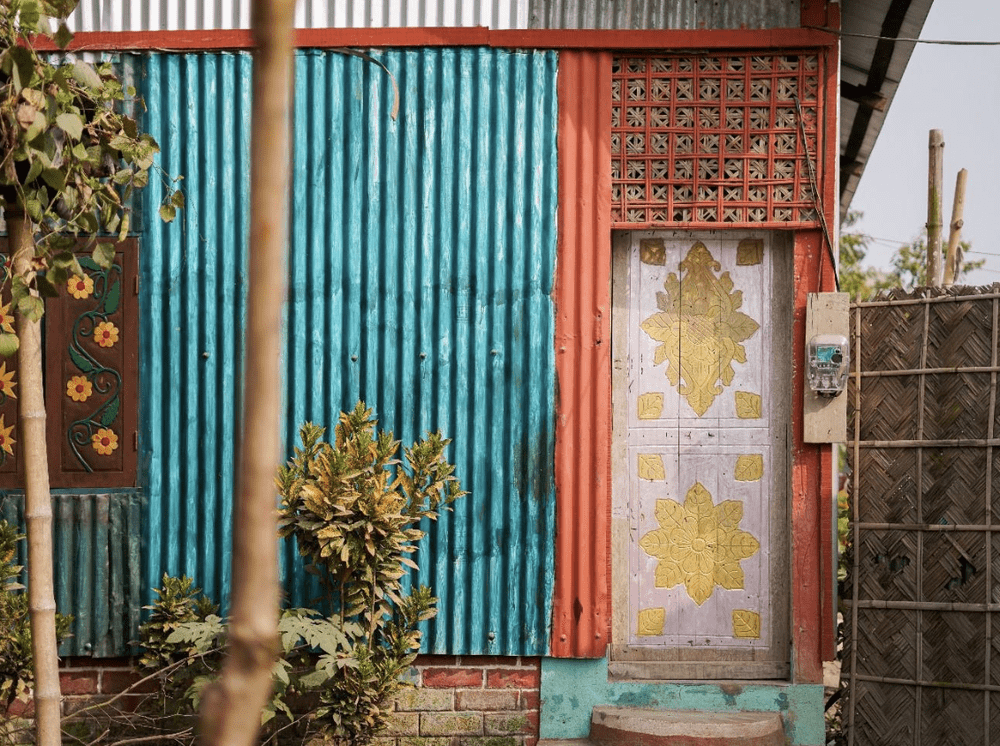
Image of a side of a home painted blue, with a pink and gold door. Trees and bushes overlap with the home in this image. Photo taken by Mano Mandal.
Who is a mehmaan?
“Who is this?”, asked an elderly schoolteacher upon entering Tahmina bhabi’s house. “Mehmaan”, Tahmina bhabhi answered, with ease, before turning to her guest. This was the first time during my field work when I did not need to tune out an introduction because of my discomfort at how I was being misgendered. When the schoolteacher left, I noticed myself feeling comfortable, and potentially even excited at this new, ambiguous and gender-neutral way of being introduced.
I lived with Tahmina bhabi (translated as sister-in-law, or equivalent social relation) and her husband, Mojibur da (brother, or equivalent social relation), during my ethnographic fieldwork between 2022-2023, researching the politics of energy access programs for environmentally displaced people in Tengaguri village, Assam, India. In this piece, I reflect on my experience of doing fieldwork, focusing on how I – a transmasculine nonbinary person – was included in public spheres (Graan, 2022) as a mehmaan: a guest. Through this, I reflect on the politics of social categories and gendered language and how they impact transgender researchers such as myself. This helps me think through how, as a trans researcher, I can belong in public spheres, which are crucial spaces of enquiry for ethnographers. While we have unique situatedness in our queer identities, I hope this post resonates in some ways with anyone subjected to the throes of watertight boxes of patriarchal social categories.
Public cultures are shaped by language. Language reflects dominant cultures. Marginalised identities slip through these categories or worse, become slurs. Dominant cultures also make ‘watertight’ categories (Khanna, 2009) with ‘discrete boundaries’ (Guyan, 2022) that lead to a loss of fluidity in categories. Given this, and often a linguistic absence for respectfully addressing queer identities, ambiguously categorised social relations such as being a ‘mehmaan’ open up queer affordances.
Having etymological roots in the Persian language, ‘mehmaan’ is widely used by Urdu speakers in India, and has found use in other languages, such as Bangla. The word itself translates to a stranger, guest, and lodger, while drawing kinship ties that flow in and out of familiarity (see Box 1). Through fieldwork, I navigated across various kinship roles, with all their gendered implications. As a category, therefore, mehmaan occupies a liminal space of familiarity and gender performance that challenges the binary notions of insider/outsider that ethnographers often talk about in terms of belonging.
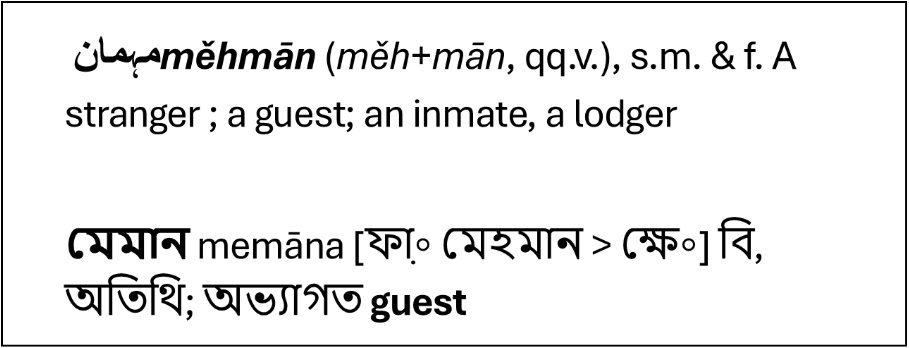
Box 1: Definition of the word ‘mehmaan’ in Urdu and Bangla. Source: Digital Dictionaries of South Asia (Dasa, 1937; Platts, 1884)
People in Tengaguri are Muslims of Bengali origin, who have a colonial history of forced migration for agricultural labour, from pre-partition Bengal to Assam, dating back to the 19th century. Muslim farmers from Bengal migrated mostly from the neighbouring Mymensingh and Rangpur districts (of present-day Bangladesh) into lower and central Assam, near the river bank, where they were encouraged by the British to grow cash crops such as jute, along with foodgrains (Chakraborty, 2009, p. 29; Goswami, 2014, pp. 8–19; Saikia, 2020, pp. 387–409). While assimilating with the dominant Assamese culture has meant curtailing much of their cultural history, Muslims of Bengali origin speak a dialect of Bangla at home. Bangla is a gender-neutral language, other than when specific relational terminologies are used. Thus, speaking in a different dialect of my mother tongue with my interlocutors ensured a sense of safety in my own gender, while being a mehmaan.
Doing ethnography as a mehmaan
How does one’s transgender identity – intersecting with other identities of social mobility, religion and caste, and language – come to be perceived during ethnographic fieldwork? Being a mehmaan, a guest, in Tengaguri produced social dynamics that must be understood at the intersection of my various identities. A shared linguistic identity eased a sense of trust for my interlocutors. At the same time, my privileges of social mobility, growing up in a metropolitan city, carrying a Hindu surname (even if low caste), and my educational status, lent a shapeshifting access into gendered spaces.
I would be out in the evenings in the marketplace and elders, all cis men, would invite me to have tea with them. Equally I found it comfortable and easy to lie on the same mat with women in the afternoons and chat, while a young mother breast-fed her baby. Internally, I felt liberated to be in both these spaces at the same time – being a mehmaan allowed me to be my nonbinary self, who did not need to play by strict gender roles, but could exist in differently gendered spaces being exactly who I was. These affordances and freedoms were essential to my gender euphoria.
Despite the liberation I felt from gendered expectations, being a mehmaan would not free me from gender dysphoria. There was a calculated risk of conformity, which I had to learn early on, trying to conform to ideas of cis gender presentations. A prominent example was that of trying to grow out my hair, in an attempt to fit in with the image of how my gender was perceived by others. This was extremely uncomfortable for me (as is for many trans people) since a few years prior to this, getting a traditionally ‘masculine’ haircut had been my first step towards gender euphoria. Carefully clothing myself in the most ‘gender neutral’ way possible, I would still have to figure out ways of taking breaks from wearing a chest binder in the Indian summer heat. I note here that gender neutrality, especially in terms of clothing choices, is often acceptable in conventionally masculine forms. A transfeminine person would have perhaps been gender-policed more harshly than me in the same context. Having a group of local queer friends to visit from time to time, who eventually helped me access gender affirming medical care after fieldwork, made maintaining my role as a mehmaan possible.
Thus, being a mehmaan was not entirely straightforward, but nonetheless, its ambiguity did afford me occasions of gender euphoria. It involved navigating aspects of gender presentation beyond the solace of gender-neutral language, which required constant vigilance and balancing between conformity with societal expectations and my internal sense of self. Given these constant navigations, being a mehmaan in Tengaguri afforded a space to inhabit different categories and expectations of a stranger, a guest, and a lodger, with demonstration of care that is often familiar in kinship ties. It gave me a space to inhabit public spheres as a queer ethnographer in unspoken terms.
Implicit knowing beyond stated categories
While I could not find ways to verbally communicate my queer identity, having known me for the year, it seemed like Tahmina bhabi and Mojibur da understood my situation in implicit ways. When Tahmina bhabi’s sister, Asminara didi, excitedly offered to dress me in a traditional feminine attire for her daughter’s wedding, a Mekhla Sador, I panicked. She was confused at my vehement refusal, but Mojibur da looked on quietly and understood. He commented that this was not how I saw myself dressing. Instead, I wore clothes like his to the wedding. Though initially disappointed, Asminara didi hosted me lovingly when we got there. While there was space for this fluidity, these affordances were perhaps possible only for a mehmaan who did not belong in Tengaguri completely. A visiting outsider could be excused from strict gendered expectations, without having to openly make sense of them. In this space, being a mehmaan was adequate to accommodate all that which could not be fitted into the watertight boxes of categories. The ambiguity in this situation was allowed to exist without necessarily needing to be explained away. At the same time, these moments were also laden with implicit acceptances of the normative gender structures that were unchallenged and unquestioned.
Can a mehmaan belong?
A few days ago, I received a video call from Tahmina bhabi and Mojibur da. I had not spoken to them for a year. They noticed that my voice had deepened, and seemed a bit confused at the changes. There was an ambiguous silence around it, but otherwise, we had a long conversation about life updates. Towards the end of the call, Tahmina bhabi caringly reminded me to eat well. Belonging in public spheres and maintaining relationships, especially cis-normative ones, comes with having to bargain for space within watertight categories that queer people don’t see ourselves belonging in.
A mehmaan is a guest, after all. A transient category of belonging, that comes with the affordances of not ticking all the requirements of expected sociality. Being a stranger, a guest, a lodger, helps one belong, even if not fully. Being a mehmaan allows for tacit acknowledgment that can temporarily lend acknowledgement and legitimacy to one’s non-normative identity. The identity of a mehmaan is conjured in transient, in-between spaces within belonging. This can be quite isolating for transgender people, given that largely, this is the predominant relationality that is offered by the cis-normative world. Being a trans ethnographer entails needing to look out for implicit knowings and affordances in maintaining relationships with a cis world, within the liminality of being a mehmaan.
-------------
Works Cited
Chakraborty, G. (2009). Assam’s Hinterland: Society and Economy in the Char Areas. https://www.abebooks.co.uk/book-search/isbn/9788183701884/
Dasa, J. (1937). Bangala Bhashara abhidana [Dictionary]. Indiyan Pablisim Hausa. https://dsal.uchicago.edu/cgi-bin/app/dasa_query.py?qs=%E0%A6%AE%E0%A7%87%E0%A6%AE%E0%A6%BE%E0%A6%A8&searchhws=yes&matchtype=exact
Goswami, M. (2014). Char Settlers Of Assam: A demographic study. MRB publishers (India).
Graan, A. (2022). Publics and the Public Sphere. In Oxford Research Encyclopedia of Anthropology. https://doi.org/10.1093/acrefore/9780190854584.013.568
Guyan, K. (2022). Queer Data: Using Gender, Sex and Sexuality Data for Action. Bloomsbury Academic.
Khanna, A. (2009). Taming of the Shrewd Meyeli Chhele: A political economy of development’s sexual subject. Development, 52(1), 43–51.
Platts, J. T. (John T. (1884). A Dictionary of Urdu, Classical Hindi, and English [Dictionary]. London, W.H. Allen & Co. https://dsal.uchicago.edu/cgi-bin/app/platts_query.py?qs=%D9%85%DB%81%D9%85%D8%A7%D9%86&searchhws=yes&matchtype=exact
Saikia, A. (2020). The Unquiet River: A Biography of the Brahmaputra. Oxford University Press.
Author bio: Mano Mandal is a PhD candidate in Social Anthropology at the University of Edinburgh. Their research explores the politics of energy access programs for environmentally displaced people in Assam, India. In addition to their research, Mano is keen on documentary photography and filmmaking.