
The house that Fiona Mackay built
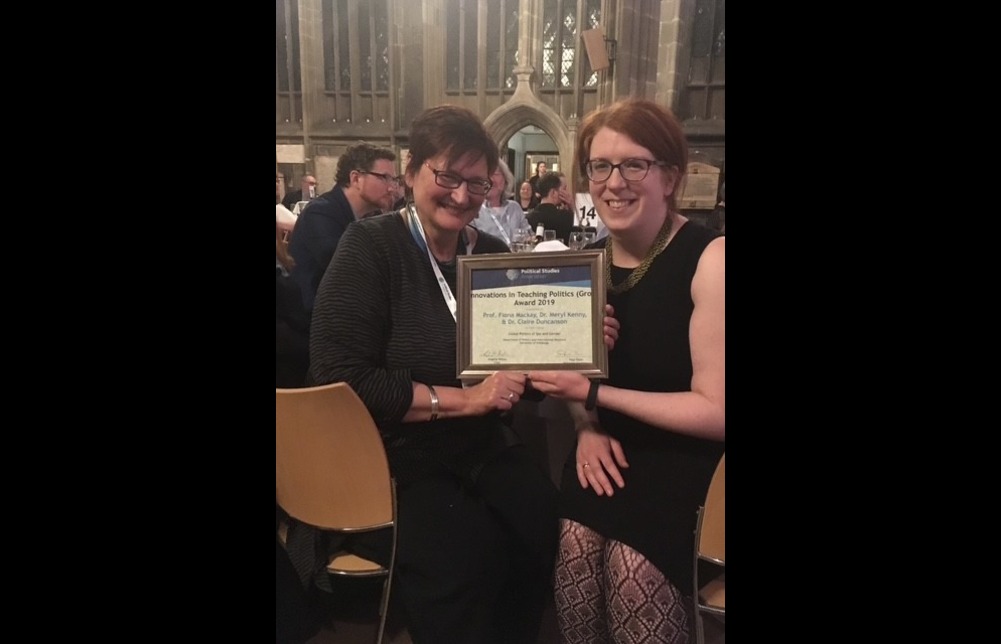
Fiona Mackay and Meryl Kenny winning an Innovation in Teaching Politics award from the Political Studies Association in 2019. Photo from Meryl Kenny
Completing our dossier of blogs one year on from Fiona Mackay's retirement, Meryl Kenny canvasses the feminist bricks and memory she has left at the University.
My first encounter with Fiona – more than two decades ago – was an intellectual, rather than an in-person one. As a parliamentary intern in the new Scottish Parliament during my undergraduate year abroad, I first came across Fiona’s scholarly work, including her anthology with Esther Breitenbach on Women in Contemporary Scottish Politics.
When I returned to the States, one of the first books I checked out from my university library shelves was Fiona’s Love and Politics, which greatly influenced my undergraduate dissertation on comparative patterns of women’s political representation. In 2004, I came back to Edinburgh and was lucky enough to be her PhD student. Since then, I have had the pleasure of being her colleague and co-author for many years, while also working with Fiona in different leadership and management roles. I am trying not to take it personally that the day before I became Head of Politics and International Relations (PIR), Fiona retired! Mostly my leadership strategy is to wake up, look in the mirror, and ask myself: ‘what would Fiona do?’
Fiona’s CV will give you the highlights of an exceptional career (and you can read more here) – the institutional and disciplinary accolades; the impact of her efforts to redress gender inequalities in political institutions, both within and beyond the academy; and her transformative academic leadership. But also important are the smaller things that have changed the institutional ‘blueprints’ of Politics and International Relations, the School and the University. She was an early supporter of the staff-student School of Social and Political Science Choir, now in its tenth year; she campaigned for the Chrystal Macmillan Building to be the first building named after a woman on campus; and she supported the case for the PIR Welcome Dinner for first year students, which has been transformative for our student experience. And yes, she also gave us a staffed School community café, until it was felled by the neoliberal university.
Equally important are the informal networks and the mentoring, support and advice that Fiona has given to so many of us and has continued to provide often long after formal line management and supervision responsibilities have ended. Although she has now retired, her leadership therapy rates remain reasonable. Her kitchen table has hosted PhD students finishing their last chapters; lecturers sweating over promotion applications; dinners and social events bringing different communities together; and a whole heck of a lot of aubergine, which it took me until after my PhD viva to finally tell her I hated. All that she usually asks for in exchange for this labour is that the recipient does the same for others.
Fiona has urged us in these reflections not to use the word ‘legacy’ and its overly grandiose connotations. So I’ll talk instead about what Sara Ahmed calls feminist bricks and feminist memory – the material through which we create our dwellings, ‘leaving a trail of where we have been and who helped us along the way’. A good feminist institutionalist would also remind us that these dwellings don't just exist 'out there' and independent of human action, they have to be brought to life through everyday practices.
In this sense, the ‘house’ that Fiona has built stands strong – instantiated through the ‘Mackay-ian’ ethos that she has instilled in so many of us. For me, this includes a commitment to making visible and elevating good citizenship; to paying it forward; to working across boundaries and building bridges; to creating more inclusive institutional cultures; and to always exercising positional power helpfully, opening up opportunities for others, and delighting in watching them thrive.
Thank you Fiona!
Author biog:
Meryl Kenny is Head of Politics and International Relations and Professor of Gender and Politics at the School of Social and Political Science.