
Integrating the Climate Crisis into the Women, Peace, and Security Agenda
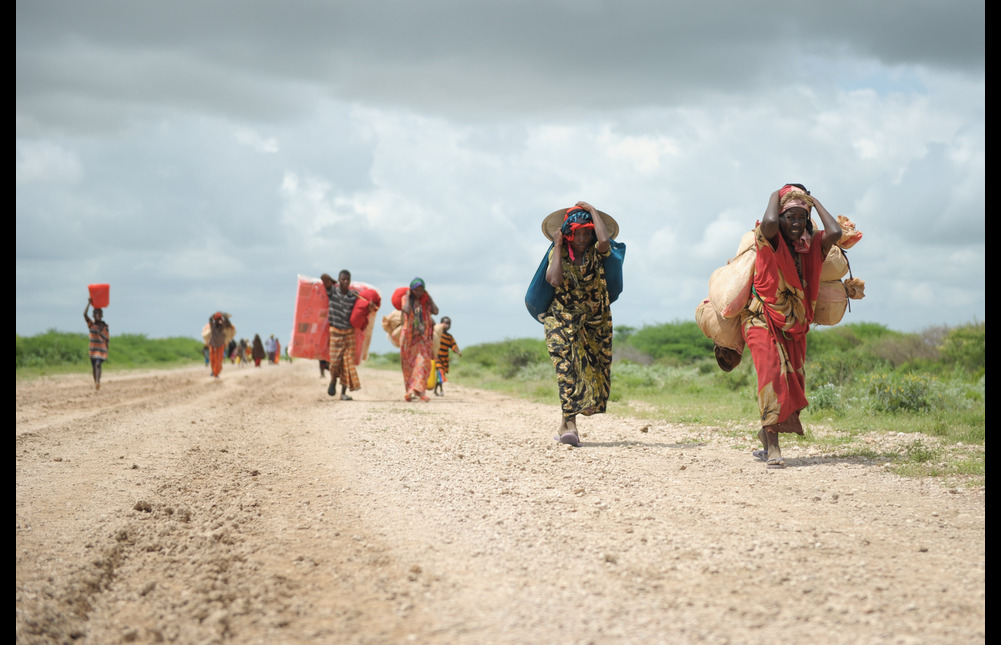
Women arrive at a camp for internally displaced people near Jowhar, Somalia, November 2013. Jones, T. (2013) Women, walking with what possessions they can carry, arrive at an IDP camp next to an AMISOM military base near Jowhar, Somalia, 12 November 2013 . AU UN IST Photo. Licensed as CC0 1.0 Universal. Available at: https://www.flickr.com/photos/au_unistphotostream/10823979704/
Climate change is a security issue for women, and addressing it means confronting structural injustice, not just disasters, argues Mia Smith.
The climate crisis intensifies global challenges, with women disproportionately affected (UN Women, 2025). Kronsell (2020) argues the Women, Peace and Security (WPS) agenda should address climate change as a security issue, recognising both immediate and slow effects on women’s lives. While Kronsell’s provocation is important, this blog contends that human security approaches alone are insufficient: the WPS agenda must address the structural drivers of climate injustice, including capitalism, extractivism, and colonial legacies. Without this broader lens, climate impacts will be treated as isolated crises.
The WPS agenda has made limited engagement with climate issues despite the recognition of climate as a cross-cutting concern in UNSCR 2242 (Yoshida, 2019). Human security offers a lens to incorporate climate concerns, as environmental degradation threatens food, water, and health, disproportionately affecting women tasked with subsistence farming and water collection (Leach, 2015; Kronsell, 2020). Atienza (2015) suggests human security can highlight everyday gendered risks, yet only 17 of 80 national WPS action plans mention climate, and just three propose concrete measures (Smith, 2020). Treating climate as peripheral risks reproducing narratives of women as passive victims while obscuring systemic drivers like capitalism and inequality (Cohn & Duncanson, 2020). Moreover, failing to integrate women’s expertise in climate adaptation and peacebuilding neglects valuable local knowledge that could inform more sustainable and gender-just interventions.
Mainstream peacebuilding equates peace with the absence of violence (negative peace), yet climate-related insecurity often manifests as prolonged, systemic conditions rather than sudden conflict (Koubi, 2019; Mach et al., 2019). Feminist scholars argue for understanding violence as a continuum, where environmental harms intersect with structural inequities (Cockburn, 2004; True, 2020; Wibben et al., 2019). Kronsell (2020) differentiates between immediate and slow climate effects. Immediate effects, such as hurricanes, floods, droughts, pose acute threats, particularly in the Global South (Thurston et al., 2021). Women’s labour in food production and water provision becomes more precarious under extreme conditions, and urban women, especially older populations, face heat vulnerability with limited adaptive resources (Kothari, 2024). These impacts compound existing inequalities: for example, disaster response mechanisms frequently fail to account for women-headed households or those with limited mobility, exacerbating exposure to harm. Slow effects, such as sea-level rise and resource degradation, constitute “slow violence” (Nixon, 2011), gradually eroding women’s security, livelihoods, and well-being (George, 2014; Yoshida, 2019). These long-term processes can also intersect with economic precarity, limiting women’s capacity to recover from repeated shocks and increasing their dependence on insecure forms of labour or humanitarian aid. Nonetheless, such temporal binaries of immediate and slow effects risk obscuring overlapping and cumulative insecurities, as well as women’s agency.
In Sudan, women mediating natural resource disputes illustrate adaptive, leadership roles in climate crises (Mitchell, Tanner & Lussier, 2007). Similarly, women in the Pacific Islands have led local adaptation strategies in response to rising sea levels, highlighting how community-led initiatives can mitigate both climate and conflict risks (George, 2014). These examples defy simplistic victim narratives and show how gendered experiences of climate breakdown are also sites of resilience, knowledge, and resistance.
To address climate insecurity within WPS, structural drivers must be confronted. Extractive capitalism underpins ecological and gendered harms, yet WPS often focuses narrowly on gender-based violence while assuming economic growth ensures peace (Dahl & Høyland, 2012). Militarised climate responses exacerbate environmental degradation, reinforcing the structures that generate insecurity (Seager, 1999; Edwards & Arneson, 2023). Extractivism, large-scale removal of resources for Northern consumption, directly contributes to climate breakdown (Acosta, 2017; Teixeira & Nicoson, 2024). Integrating climate into WPS also demands confronting the colonial roots of extractivism. Historical patterns of resource exploitation, racialised violence, and land dispossession continue under the guise of green transition and climate policy, often displacing Indigenous communities and perpetuating structural inequalities (Karmakar & Chetty, 2023; Lang et al., 2024). Peacebuilding that ignores these dynamics risks perpetuating the injustices it seeks to redress, as in post-conflict extractive projects in the Andes-Amazon region, which continue to marginalise Indigenous women despite formal peace agreements (Murillo-Sandoval et al., 2021). The WPS agenda’s limited engagement with these dynamics reproduces hierarchies, positioning the Global South as passive recipients of Northern-led norms (Parashar, 2018; Achilleos-Sarll, 2022).
Meaningful integration of climate security into WPS therefore requires decolonial, anti-extractivist approaches, centring Southern leadership and local knowledge while challenging the global capitalist structures that perpetuate both environmental and gendered harm (Escobar, 2000; Simangan, 2024). Emerging frameworks, such as the ‘rights of nature’, offer alternatives by recognising ecosystems as rights-bearing entities (Boyd, 2017; Yoshida, 2021). Colombia’s 2018 Supreme Court decision granting legal rights to the Amazon exemplifies this approach, although implementation remains limited due to ongoing extractive activity (Clerici et al., 2020; Krause et al., 2022). Similarly, post-growth and post-extractivist frameworks, such as Brazil’s ‘Buen Vivir’ and Landless Workers Movement, emphasise ecological sustainability, collective care, and decolonial justice over growth-driven peacebuilding (Teixeira & Koşanay, 2024; Teixeira & Nicoson, 2024). These movements demonstrate that grassroots, community-led initiatives can address overlapping climate, ecological, and gendered insecurities. Without this shift, interventions risk being superficial, securitised, and divorced from the realities of the communities most affected.
While Kronsell’s (2020) call to consider both immediate and slow climate effects is important, the WPS agenda must move beyond thematic inclusion. Addressing climate insecurity requires confronting structural drivers such as extractivism, patriarchal capitalism, and colonial legacies. Without this structural lens, the WPS agenda risks reproducing the very inequalities it seeks to mitigate, treating climate as an add-on rather than a core driver of gendered insecurity. Integrating decolonial, ecological, and post-growth perspectives offers a pathway towards a WPS framework capable of addressing both climate breakdown and the broader matrix of systemic violence, creating a more just, inclusive, and sustainable peace.
Author bio:
Mia Smith is a 4th year Undergraduate student studying Sustainable Development (Politics and International Relations Pathway).
This essay, originally written for the semester 2 course Gender, Peace and Security, won second prize in the Political Studies Aassociation’s ‘Women and Politics’ Undergraduate Essay Competition 2025.
References
Achilleos-Sarll, C. (2022) ‘The (Dis-)Appearance of Race in the United Kingdom’s Institutionalization and Implementation of the Women, Peace and Security Agenda’, International Studies Quarterly, 67(1). Available at: https://doi.org/10.1093/isq/sqad006 (Accessed: 1 October 2025).
Acosta, A. (2017) ‘Post-Extractivism: From Discourse to Practice—Reflections for Action’, International Development Policy/Revue Internationale de Politique de Développement, 9, pp.77–101. Available at: https://doi.org/10.4000/poldev.2356 (Accessed: 1 October 2025).
Atienza, M.E.L. (2015) ‘People’s views about human security in five Philippine municipalities’, Disaster Prevention and Management: An International Journal, 24(4), pp.448–467. Available at: https://doi.org/10.1108/dpm-12-2014-0277 (Accessed: 1 October 2025).
Boyd, D.R. (2017) The Rights of Nature: A Legal Revolution That Could Save the World. Toronto: ECW Press.
Clerici, N., Armenteras, D., Kareiva, P., Botero, R., Ramírez-Delgado, J.P., Forero-Medina, G., Ochoa, J., Pedraza, C., Schneider, L., Lora, C., Gómez, C., Linares, M., Hirashiki, C. and Biggs, D. (2020) ‘Deforestation in Colombian protected areas increased during post-conflict periods’, Scientific Reports, 10(1). Available at: https://doi.org/10.1038/s41598-020-61861-y (Accessed: 1 October 2025).
Cockburn, C. (2004) The Continuum of Violence: A Gender Perspective on War and Peace. University of California Press. Available at: https://doi.org/10.1525/california/9780520230729.003.0002 (Accessed: 1 October 2025).
Cohn, C. and Duncanson, C. (2020) ‘Women, Peace and Security in a changing climate’, International Feminist Journal of Politics, 22(5), pp.742–762. Available at: https://doi.org/10.1080/14616742.2020.1843364 (Accessed: 1 October 2025).
Dahl, M. and Høyland, B. (2012) ‘Peace on quicksand? Challenging the conventional wisdom about economic growth and post-conflict risks’, Journal of Peace Research, 49(3), pp.423–429. Available at: https://doi.org/10.1177/0022343312436767 (Accessed: 1 October 2025).
Edwards, N. and Arneson, B. (2023) ‘The Challenge of Demilitarizing the Response to Climate Change’, World Peace Foundation. Available at: https://worldpeacefoundation.org/blog/the-challenge-of-demilitarizing-the-response-to-climate-change/ (Accessed: 1 October 2025).
Escobar, A. (2000) Beyond the Search for a Paradigm? Post-Development and Beyond. Development, 43(4), pp.11–14. Available at: https://doi.org/10.1057/palgrave.development.1110188 (Accessed: 1 October 2025).
George, N. (2014) ‘Promoting Women, Peace and Security in the Pacific Islands: Hot conflict/slow violence’, Australian Journal of International Affairs, 68(3), pp.314–332. Available at: https://doi.org/10.1080/10357718.2014.902032 (Accessed: 1 October 2025).
Karmakar, G. and Chetty, R. (2023) ‘Tackling Environmental and Epistemic Injustice: Decolonial Approaches for Pluriversal Peacebuilding in South Africa’, Peace Review, 35(3), pp.496–510. Available at: https://doi.org/10.1080/10402659.2023.2208519 (Accessed: 1 October 2025).
Kothari, A. (2024) Cooling the Divide: Building Gender-Inclusive Urban Heat Resilience. Harvard Kennedy School. Available at: https://www.hks.harvard.edu/sites/default/files/2024-05/HKS%20PAE_Aditi-Kothari_20242.pdf (Accessed: 1 October 2025).
Koubi, V. (2019) ‘Climate Change and Conflict’, Annual Review of Political Science, 22(1), pp.343–360. Available at: https://doi.org/10.1146/annurev-polisci-050317-070830 (Accessed: 1 October 2025).
Kronsell, A. (2020) ‘WPS and Climate Change’, in The Oxford Handbook of Women, Peace, and Security. Oxford Academic. Available at: https://doi-org.eux.idm.oclc.org/10.1093/oxfordhb/9780190638276.013.55 (Accessed: 1 October 2025).
Leach, M. (ed.) (2015) Gender Equality and Sustainable Development. Routledge. Available at: https://doi.org/10.4324/9781315686455 (Accessed: 1 October 2025).
Mach, K.J., Kraan, C.M., Adger, W.N., Buhaug, H., Burke, M., Fearon, J.D., Field, C.B., Hendrix, C.S., Maystadt, J.-F., O’Loughlin, J., Roessler, P., Scheffran, J., Schultz, K.A. and von Uexkull, N. (2019) ‘Climate as a risk factor for armed conflict’, Nature, 571(7764), pp.193–197. Available at: https://doi.org/10.1038/s41586-019-1300-6 (Accessed: 1 October 2025).
Mitchell, T., Tanner, T. and Lussier, K. (2007) We know what we need: South Asian women speak out on climate change adaptation. ActionAid, University of Sussex: Institute of Development Studies. Available at: https://actionaid.org/sites/default/files/actionaid__ids_report___we_know_what_we_need_-_asian_women_speak_out_about_climate_change_adaptation.pdf (Accessed: 1 October 2025).
Murillo-Sandoval, P.J., Gjerdseth, E., Camilo Correa-Ayram, Wrathall, D., Den, V., Dávalos, L.M. and Kennedy, R. (2021) ‘No peace for the forest: Rapid, widespread land changes in the Andes-Amazon region following the Colombian civil war’, Global Environmental Change, 69, 102283. Available at: https://doi.org/10.1016/j.gloenvcha.2021.102283 (Accessed: 1 October 2025).
Nixon, R. (2011) ‘Slow Violence, Gender, and the Environmentalism of the Poor’, in Slow Violence and the Environmentalism of the Poor, pp.128–149. Harvard University Press. Available at: https://doi.org/10.4159/harvard.9780674061194.c4 (Accessed: 1 October 2025).
Parashar, S. (2018) ‘The WPS Agenda’, in The Oxford Handbook of Women, Peace, and Security, pp.828–839. Oxford University Press. Available at: https://doi.org/10.1093/oxfordhb/9780190638276.013.46 (Accessed: 1 October 2025).
Seager, J. (1999) ‘Patriarchal Vandalism: Militaries and the Environment’, in Sillima, J.M. and King, Y. (eds.) Dangerous Intersections: Feminist Perspectives on Population, Environment, and Development, p.164. Boston, MA: South End Press.
Simangan, D. (2024) ‘Post-growth peacebuilding’, Review of International Studies, 50(5), pp.877–887. Available at: https://doi.org/10.1017/s026021052400007x (Accessed: 1 October 2025).
Smith, E.S. (2020) Climate Change in Women, Peace and Security National Action Plans. SIPRI Insights on Peace and Security. Available at: https://www.sipri.org/sites/default/files/2020-06/sipriinsight2007.pdf (Accessed: 1 October 2025).
Teixeira, B.M. and Nicoson, C. (2024) ‘Transforming environmental peacebuilding: addressing extractivism in building climate resilient peace’, Ecology and Society, 29(3). Available at: https://doi.org/10.5751/es-14860-290302 (Accessed: 1 October 2025).
Thurston, A.M., Stöckl, H. and Ranganathan, M. (2021) ‘Natural hazards, disasters and violence against women and girls: a global mixed-methods systematic review’, BMJ Global Health, 6(4), e004377. Available at: https://doi.org/10.1136/bmjgh-2020-004377 (Accessed: 1 October 2025).
True, J. (2020) ‘Continuums of Violence and Peace: A Feminist Perspective’, Ethics & International Affairs, 34(1), pp.85–95. Available at: https://doi.org/10.1017/s0892679420000064 (Accessed: 1 October 2025).
UN Women (2025) How gender inequality and climate change are interconnected. Available at: https://www.unwomen.org/en/articles/explainer/how-gender-inequality-and-climate-change-are-interconnected#:~:text=Climate%20change%20is%20a%20%E2%80%9Cthreat,forms%20of%20gender%2Dbased%20violence (Accessed: 1 October 2025).
Wibben, A.T.R., Confortini, C.C., Roohi, S., Aharoni, S.B., Vastapuu, L. and Vaittinen, T. (2019) ‘Collective Discussion: Piecing-Up Feminist Peace Research’, International Political Sociology, 13(1), pp.86–107. Available at: https://doi.org/10.1093/ips/oly034 (Accessed: 1 October 2025).
Yoshida, K. (2019) ‘The nature of women, peace and security: where is the environment in WPS and where is WPS in environmental peacebuilding?’, LSE Research Online. Available at: http://eprints.lse.ac.uk/103208/1/Yoshida_nature_of_women_peace_and_security_published.pdf (Accessed: 1 October 2025).
Yoshida, K. (2021) Recognise the Rights of Nature. Pluto Press, pp.166–180. Available at: https://doi.org/10.2307/j.ctv23hcfk8.17 (Accessed: 1 October 2025).