
Stepping Up or Stepping Down? Gendered Health Labour in Kenya
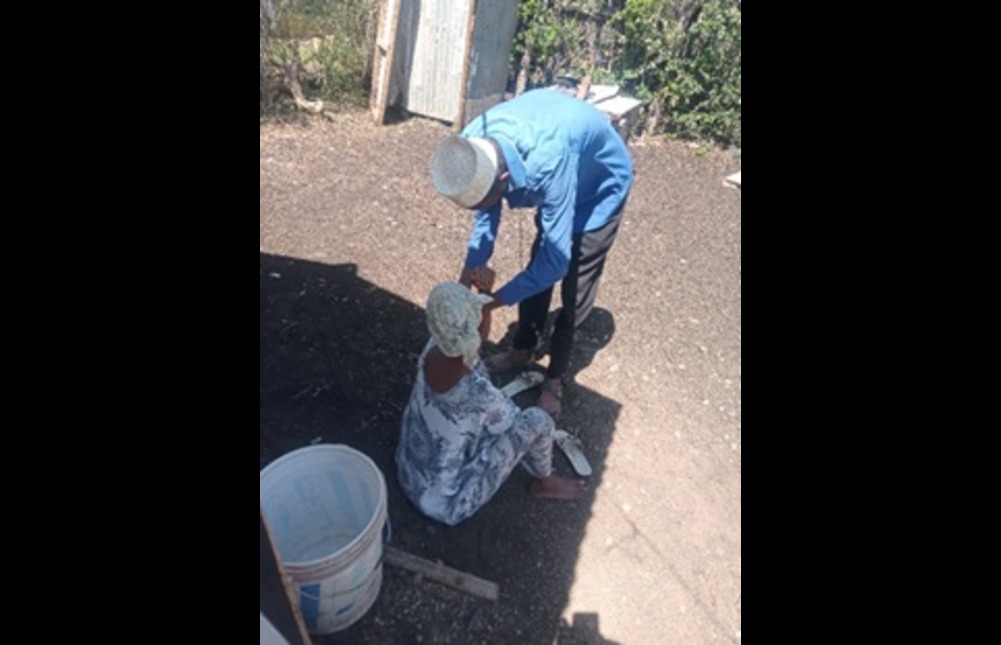
Male CHV assesses pregnant patient in Isiolo.
Credit: authors' own. Taken and shared with the CHV's permission.
The face of care work, both paid and unpaid, is famously female. However, in northern Kenya, the majority of Community Health Volunteers are men. Drawing on the life stories of both men and women, we explore shifting labour norms in this part of Kenya, whereby ‘modern’ gig labour sat in conflict with the proud and autonomous pastoralist livelihood.
For millions of people, especially across Africa, healthcare doesn’t begin in surgeries or hospitals but in homes. It begins with the local men and women who work without salary to bridge the gap between households and formal health systems. These are the Community Health Workers (CHWs) and this face of such work, which remains overwhelmingly voluntary in Africa, is famously female. In northern, pastoralist Kenya, however, half of CHWs are men and, in rural areas, men formed the majority, defying national and regional trends.
So, what happens when men step into this kind of feminized and precarious work?
At first, these numbers looked like progress towards gender balance and equality. Male CHVs might be well-placed, for example, to incorporate male health into an outreach system that has historically prioritized maternal and child health. When employing a labour lens, however, rather than making assumptions about community health as altruistic community service, a different picture emerges. It is a picture that points to changes in labour and gender norms in this part of Kenya.
While there is wide-ranging, feminist work that explores the perspectives of female CHVs, we used our case of Isiolo, northern Kenya, to explore men’s entry into such labour. Using a life history (or rather a ‘life story’ approach), we traced pathways into unsalaried health work by pastoralist men.
Based on a year of ethnographic fieldwork and the life stories of both men and women, we unpack the tensions taking up this work regarding what it means to be a man, what it means to have a job and, ultimately, what it is to belong.
In do doing, we discovered the socio-economic tradeoffs and the internal conflicts men experienced in taking up the community health mantle. In a region that once eschewed waged labour as a sign of dependency and social inferiority, rejecting the colonizer over decades, ad hoc, part-paid development work had seeped into the lives of pastoralist men. Such men had become increasingly aid dependent as livelihoods faltered, as a result of colonial and postcolonial violence at the hands of the state.
To understand this conflict, we drew on Dorothy Hodgson’s ‘dual masculinities’ in pastoralist east Africa. One is ‘modern’: investing in education, seeking a stable wage and professional status. The other is ‘traditional’, valuing freedom, mobility and independence. We found both in the minds of male CHWs, generating distress or what Fanon might term ‘psychosocial angst’.
In one memorable story of a sole man in a large unit of women, the lack of payoff from investment in this ‘modernist’ masculinity of education and waged employment, was stark:
As pastoralists, my parents made the decision to advance my education, which led to my enrolment at [government secondary] […] In 2000, while I was in Form Three, another wave of clashes erupted in our area. Our livestock was taken by our neighbours […]. Tragically, my father went to confront them and was killed […] I was left behind with my mother and four siblings, along with the property my father had left. However, I had to forgo one term of schooling during that time. Eventually, in the third term, my father’s brother suggested selling the cattle so I could return to school, believing that I was now ready to focus on my studies. Thus, I resumed my studies in the third term and completed my Form Four education in 2001.
This CHV volunteered as a primary teacher for seven years, in the hope he may become salaried; but as more stringent qualifications were brought in, he was let go. He was taken on as a volunteer at the dispensary but subject to ridicule by his peers for his commitment to ‘women’s work’ or ‘free work’, asking him ‘are you a woman?’.
By the time we first met him in a monthly meeting, he appeared dejected and disengaged, which we learned as stemming from his emasculation and loss of self-esteem as a provider.
In view of these tensions and trade-offs, we developed our ‘step up, step down’ framework, whereby in the absence of other income generation, men took up such work as a potential 'step up', denying women such opportunities. As stability and status were not realised, however, rural men found themselves trapped in feminized care work in ways that arguably held them back.
We do not argue that men and women do not benefit from community health labour in Kenya or elsewhere. Our argument is that Community Health work is not best understood as a form of voluntarist community service but, in this part of Kenya, as akin to a form of gig labour. This was most stark in urban areas (where women formed the majority), whereby men treated it as any other ‘hustle’ and felt no conflict in walking away when such work did not prove materially beneficial.
Rather than moralising about the ‘right’ motivations for community service, male CHVs’ dilemmas in Isiolo must be understood via norms of both the salaried breadwinner and the autonomous pastoralist.
We believe our focus on men reveals the ways in which women remain subordinated in hierarchies of work. Rather than a picture of gender equity, women benefit from work that men pass over. But as conditions improve but precarity worsens, men do not pass it over indefinitely.
We believe there is broader applicability in our work. The conditions of community health work are improving across Africa, as elsewhere. National and international bodies must ensure that long-serving women are not ousted and that equal recruitment is protected, without putting women at risk.
Our second conclusion is about rural work economies, whereby men in rural Kenya have not been well served by ad hoc labour regimes. The lack of secure employment has allowed the acceptance of poor, risky conditions, producing a hierarchy of exploitation with gender and ethnic dimensions.
In short, the lack of secure livelihoods in Kenya puts men at risk, which puts women at risk. While still protecting the prioritization of women, our work shows how the exclusion of rural men from national development leads to worse outcomes for women in Africa.
Author bios:
Kathy is a Research Fellow in the Department of International Development, King’s College London, previously at the University of Edinburgh. Kathy was awarded a Wellcome Trust fellowship to study the trajectories of Community Health Volunteers in Kenya (2021-2025) and has published in Global Public Health, Third World Quarterly, Social Science & Medicine and Development & Change on this topic. Her monograph Legitimation as Political Practice: Crafting Everyday Authority in Tanzania came out with Cambridge University Press in 2022. www.kathy.dodworth.com
Brenda is a social anthropologist based in Nairobi, with longstanding research experience in public health and gender. She has coauthored research on community health in Global Public Health, Third World Quarterly and Social Science & Medicine, as well as a brief on Kenya’s digitization of community health. She is currently conducting research on digital innovations in healthcare in Tanzania, in collaboration with the University of Oslo and the University of Dar es Salaam. A video abstract by Brenda about the paper on which this blog is based, can be found at https://www.youtube.com/watch?v=bmMAuGAd3Xs
References:
Dodworth, Kathy, and Brenda N. Mukungu. 2023. ‘“Our Hands Are Bound”: Pathways to Community Health Labour in Kenya’. Social Science & Medicine 332 (September): 116–26. https://doi.org/10.1016/j.socscimed.2023.116126.
Dodworth, Kathy, and Brenda N. Mukungu. 2025a. ‘Fever Pitch: Coloniality and Contention within Community Health’s Yellow Fever Response in Kenya’. Global Public Health 20 (1): 2519659. https://doi.org/10.1080/17441692.2025.2519659.
Dodworth, Kathy, and Brenda N. Mukungu. 2025b. ‘Step up, Step down, Step out: The Gendering of Community Health Work in Pastoralist Kenya’. Third World Quarterly 0 (0): 1–20. https://doi.org/10.1080/01436597.2025.2576789.