
Toxic narratives: patriarchal menstrual discourse in Bollywood’s Pad Man
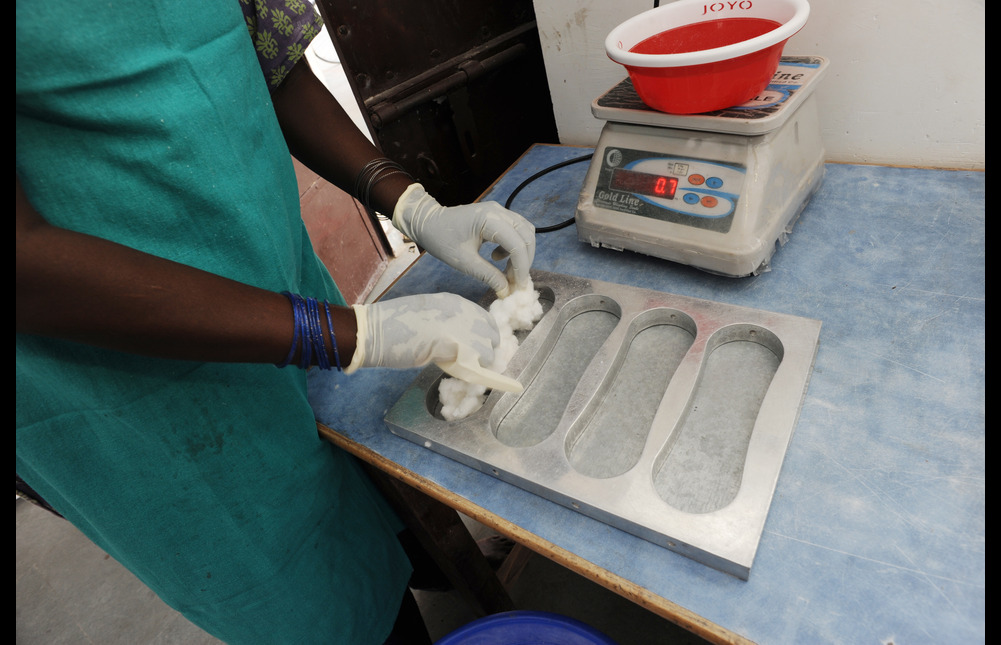
Image: Sanitary towel manufacturing by Lar Boland for Barefoot College, Licenced under CC BY-SA 4.0.
In this blog post, Kaashvi Shah critically examines Pad Man’s portrayal of menstruation, challenging its mainstream feminist framing. Drawing on her research, she reveals how the film reproduces patriarchal, casteist, and neoliberal narratives under the guise of empowerment.
The film Pad Man follows the figure of Lakshmi, a rural inventor who sets out to manufacture low-cost sanitary pads for women in his community. Lakshmi’s inspiration comes from his dutiful, religious wife Gayatri, whose discomfort with menstruation spurs his innovation.
Since its release in 2018, the film Pad Man has been widely praised for challenging menstrual stigma. Framed as a progressive menstrual intervention based on the life of rural innovator Arunachalam Muruganantham, the film portrays sanitary pads as a transformative tool of empowerment. It has been celebrated by NGOs and media outlets. In 2020, Indian Prime Minister Narendra Modi used his Independence Day address to highlight the provision of one-rupee sanitary pads. This moment marked menstruation’s entry into nationalist and developmental discourse. Once relegated to silence, menstruation was now reframed as a site of state intervention and cultural governance.
But what if Pad Man isn’t quite the feminist intervention it appears to be? My dissertation project questioned this popular narrative. While the film seems to raise awareness, it also reproduces ideological frameworks that shape how menstrual bodies are governed. By embedding menstrual hygiene within discourses of purity, productivity, and national duty, perplexingly Pad Man reconfigures stigma rather than dismantling it.
Using Critical Discourse Analysis, drawing on feminist geography, subaltern studies, and postcolonial critique, I analysed the film’s visual, linguistic, and sonic cues to understand how menstruation is framed in relation to caste, nationhood, and neoliberal empowerment.
One of the most striking findings from my research is how the film positions sanitary pads as not just a practical tool, but a moral one. While Pad Man presents pads as liberating, they are framed as the only legitimate solution to menstrual stigma. Cloth, historically and presently used across the Global South, is depicted as backwards and unsanitary. This reduction of menstruation to a hygiene crisis depoliticises it, removing caste, religion, or social inequality from the equation in favour of medicalised discourse.
This framing echoes the NGO-isation of the women’s movement in India, where complex social struggles have often been reduced to technocratic “solutions”. Pad Man valorises the sanitary pad as a neat, scalable intervention, divorced from the messy realities of caste, poverty, and embodied experience. Rather than addressing systemic stigma or supporting grassroots organising, the film promotes a model of empowerment through individual entrepreneurship, aligning with neoliberal development logics that privilege innovation and product-based social change.
At the same time, Pad Man erases the caste identity of the real-life innovator on which it is based. The lower-caste, South-Indian Tamil innovator, Arunachalam Muruganantham, is recast as an upper-caste, North-Indian Hindi-speaking reformer. The film also delegitimises subaltern epistemologies, particularly religious or spiritual views of menstruation, by portraying them as irrational. For example, Lakshmi’s wife Gayatri voices beliefs rooted in dharmashastric notions of purity, which undeniably reinforce caste-patriarchal stigma. Yet the film resolves this tension by ridiculing Gayatri herself, shifting the blame for menstrual stigma onto individual women rather than interrogating the structural power of Brahmanical patriarchy. What appears reformist, replacing ‘superstition’ with biomedical rationality, in fact silences the complex, situated experiences of menstruators in India, especially those from Dalit, Adivasi, and other marginalised communities.
Crucially, the film recasts menstrual stigma as a personal failure rather than a structural issue. It individualises responsibility, suggesting that empowerment comes through self-management and entrepreneurial solutions. The sanitary pad is presented not just as a product, but as a pathway to national progress. In the film’s climactic UN speech, Lakshmi claims that pads offer “extra life” and in a moment of struggle to sell his pads exclaims “if they want to die, let them!”. Here he implies that menstruators place their lives at risk unless they are managing their periods in a particular, state-sanctioned way. This rhetoric reproduces both neoliberal and Hindutva ideologies, in which bodily discipline is tied to citizenship and national belonging.
Ultimately, Pad Man invites us to celebrate progress, but on very narrow terms. Menstruating bodies become a symbol of development through their management. Pads become emblems of discipline and progress. The messier realities of bleeding, pain, and stigma remain out of frame. We must be critical of feel-good narratives that mask deeper exclusions. Periods are not just medical or sanitary issues. They are shaped by caste, gender, nationhood, and power. Until we address those entanglements and engage with the heterogeneity of menstruation, menstrual justice remains unrealised.
Author biog:
Kaashvi Shah trained in Human Geography at the University of Edinburgh and is currently tracing embodiment through a Masters in Medical Anthropology and Mental Health at SOAS. She is also interested in feminist and decolonial creative methods, including zine-making and painting-as-method, and in health narratives surrounding key life-stage events.