
Whither feminist leadership in the academy?
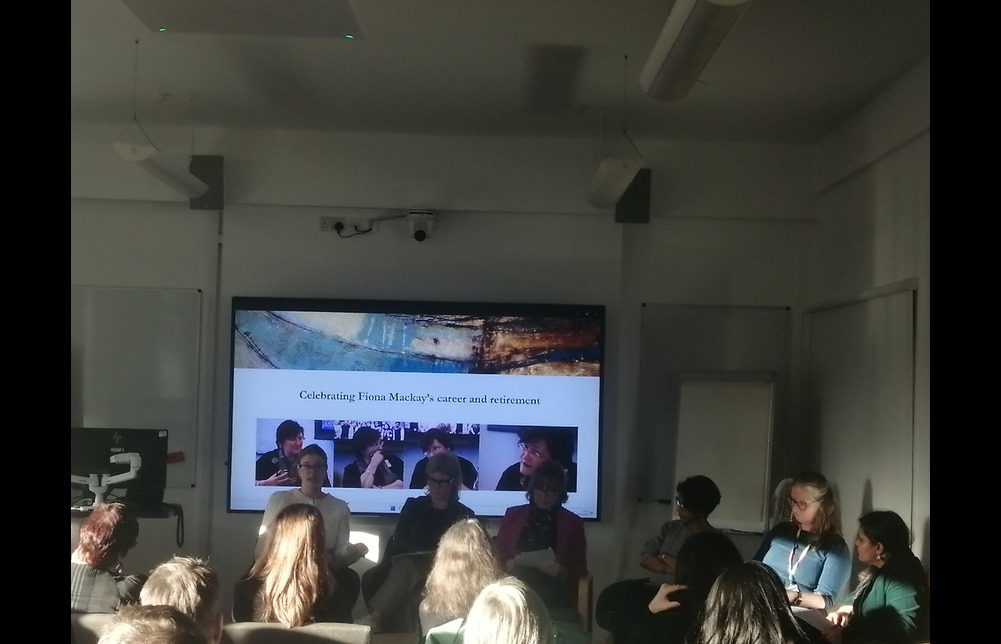
A glimpse of the panel, left-to-right: Leah McCabe, Claire Annesley, Lesley McAra, Krithika Srinivasan, Beckie Marsland and Radhika Govinda. Photo by Kaveri Qureshi
Continuing our dossier on Fiona Mackay's retirement, GENDER.ED reports on a salon exploring feminist leadership in the academy and taking stock of Fiona's idea of the "tempered radical".
One of Fiona Mackay’s academic contributions is to develop the notion of the “tempered radical” to think through the work of feminist leaders in the academy. A “tempered radical” is one who “works within existing structures to challenge the gendered status quo despite the perils of co-option and complicity” (Mackay 2021, 76).
At Fiona’s retirement this time last year, Politics and International Relations organised a roundtable on feminist leadership in the academy to mark Fiona’s contributions and canvas the challenges and learnings of a number of feminist academic colleagues at different career stages, schools and leadership contexts within the University of Edinburgh and beyond. It was an intimate event, with difficult experiences shared frankly.
The roundtable and responses featured former GENDER.ED Director Dr Radhika Govinda, Professor Cristina Boswell, Dr Hazel Grey, Dr Claire Houghton, Professor Meryl Kenny, Dr Beckie Marsland and Dr Leah McCabe from School of Social and Political Sciences, Professor Krithika Srinivasan from the School of Geosciences, Professor Yvette Taylor from Strathclyde University and Professor Claire Annesley from UNSW Sydney, and was chaired by Professor Lesley McAra as then Director of IASH.
Notable questions were: do feminists need to be in leadership and management in the academy or are the costs too high? How to push back against the over-emphasis on feminist leaders’ caring roles, while care remains central to feminist praxis? How may feminist principles serve us in a period of retrenchment?
Around the room, contributors chafed against mainstream academic leadership programmes which individualise leadership as a personal attribute or capacity, failing to attend to context or structure. They identified being a feminist leader as: combining attention to the big picture and day-to-day detail, being guided by feminist principles of courage, reflexivity, consultation, consensus-building, accountable collaboration, inclusive and shared responsible use of power. Consensus was noted to be a difficult object to pursue, and not an intrinsic good. Sometimes the appearance of consensus can be mobilised to conceal dissent. In which case, a feminist leader can amplify moments of dissent so that “they, or you aren’t the only troublemaker in the room”.
There is a paradox to feminist leadership: you need positional power to get things done and implement the changes you want to see. But consensus-building, contributors noted, can entail strategic compromises and then having to live with one’s conscience. Sometimes, contributors noted, it can feel ok to “pick your battles” and “come back another time and in another way”. Sometimes however, consensus-building can threaten your sense of political integrity. Further, contributors noted how occupying a seat at the table brings heightened intersectional microagressions.
Some, who shared Fiona’s feminist institutionalist academic background (see tomorrow’s blog on feminist institutionalism) identified the value of the toolkit this provides for academic leadership contexts, asking: how are things done around here? What are the rules, the power dynamics? Who matters, who do you have to work with to get things done? These questions can expose which rules need to change; formal or informal. An example was of the injustice of how, in one speaker’s context, predictable colleagues were being “tapped on the shoulder” for leadership roles. So, she instituted a requirement of expressions of interest, with no seniority prerequisites, and was happy to have “recruited incredible leaders into my team who never aspired to office”.
On the costs of feminist leadership, there was frank recognition of the terrible job the academy does as an institution, as a sector, of supporting women mid-career and often also mid-life; centring pressures which are even more acute for particular bodies (the perfect storm of older generation care, small children, personal health). Many around the room had undertaken feminist leadership positions during the piqued burdens of COVID-19: “I couldn’t believe nobody asked me, how’s it going, how are you managing this alongside having two children at home”. They noted how starkly the expectations of care around leadership roles are gendered, highlighting the need to challenge the “affected incompetent” who never gets asked to do roles as well as those people who have an “informed incapacity to care”, “when some bodies wear leadership so lightly what does this mean, we need to talk about underwork as well as overwork”.
In spite of the inequalities around leadership, and its costs, contributors agreed that it’s better that leadership roles were done by feminists than not. “Is it better to leave it to the non-feminists? Somebody has to do jobs which are about making the least-worst decision”. As one put it, “you do notice it, when you’re not being led by a feminist leader”. This was an urgent question in this moment of institutional restructuring and budget cuts. One said, “I wonder where feminist leadership is within our response to the current moment… It’s not an easy question, whether feminists should stand back or step forward at the moment”. When feminists decide they can’t be complicit in decisions, there are vacuums which need to be addressed by other channels. “Sometimes we may need to step back for self-care, but collectively we need to remove our labour from leadership in effective ways".
Alongside all the frustrations, achievements, and tactics shared, the roundtable offered an opportunity to return to Fiona’s offering of the “tempered radical” and take stock of this suggested feminist leadership figure in the current moment. It was suggested that in the current moment, “we need less of the tempered radical, and more of the radical”. For others, the “tempered radical” felt to make sense in terms of combining radical ideas and oppositional knowledge, with tempered expectations and executions of those ideas, and embracing “small wins” that can lead to more secure transformations.
In her concluding comments, Fiona brought everyone back to the issue of care. She pointed out that feminist leadership and responsibility need to be considered as part of a collectivity. “We need to care about feminist leaders”. Ultimately Fiona argued against giving in to despair, citing Dr Becky Hewer’s work on utopianism and trying to continue to imagine a better future. She encouraged everyone to try to practice joy even in really dark times, and hold on to the idea that the university can be something good.
References:
Mackay, F. (2021). Dilemmas of an academic feminist as manager in the neoliberal academy: Negotiating institutional authority, oppositional knowledge and change. Political Studies Review, 19(1), 75-95.