
Who owns the epic? Reimagining the Mahabharata from Below
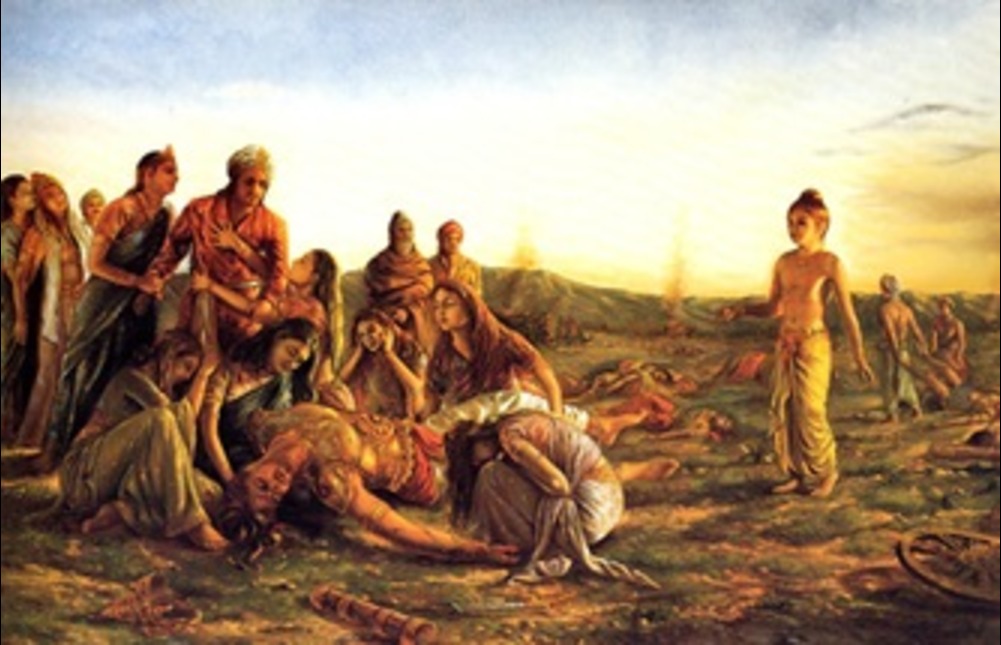
"Mahabharata after War" by william2021 is licensed under CC BY 2.0.
This blog post draws on feminist, indigenous, and queer reinterpretations of the Mahabharata to reflect on how mythological narratives are mobilized and contested within the dominant Hindu nationalist discourse. Avani Tilekar explores how the characters Draupadi, Shikhandi, and Hidimbi offer radical alternatives to hegemonic gendered and casteist readings of the epic.
What if the Mahabharata’s most compelling figures were not upholders of the patriarchal order, but its fiercest critics? What if angry mothers, indigenous women, and queer warriors were not peripheral to the epic’s narrative, but rather central to it? In the era of a dominant Hindutva regime in contemporary India, ancient epics like the Mahabharata and the Ramayana have become tools of ideological construction. Their characters are rebuilt to serve the patriarchal, Brahminical and heteronormative ideal. However, these cultural texts have never been static. Through feminist, indigenous, and queer lenses, we can recover the epic’s radical foundations, and reimagine mythology as a space for resistance.
Drawing from my undergraduate dissertation, this blog discusses how alternative interpretations of the Mahabharata destabilize exclusionary narratives and reclaim the epic as a site of pluralism and transformative possibility.
Myth as a Political Battleground
Mythology is a tool of cultural reproduction. As Nira Yuval-Davis argues, women are central to reproducing the nation, both biologically and ideologically. In the context of the Brahminical patriarchy, outlined by Uma Chakravarti, women’s bodies and roles are tightly regulated to preserve caste purity, lineage, and national honor. Hindu nationalist ideologies therefore often draw on the Mahabharata to present a ‘civilizational’ heritage rooted in gendered sacrifice and morality. This reading flattens the text’s complexity. The epic itself is full of contradictions, ambiguities, and transgressions: qualities that feminist and queer scholars have long embraced.
Draupadi’s Rage as Political Fire
Draupadi’s story is perhaps the most viscerally gendered in the epic, from her polyandrous marriage to her public humiliation in court. In popular media, such as in B.R. Chopra’s television series Mahabharat (1988), her rage is tamed and reframed as dutiful rather than defiant. But in feminist reinterpretations, Draupadi is not a passive victim— she is a catalyst.
Using Judith Butler’s theory of gender performativity and Naila Kabeer’s idea of bounded agency, Draupadi’s resistance can be re-read as transformative. Her refusal to stay silent in the Kuru court marks a break from submissive femininity and reclaims female anger as a legitimate political force. She does not just endure; she demands retribution— and the war that follows begins with her fire.
Caste, Indigeneity, and the Epic’s Margins
Beyond the royal palace, the epic features characters such as Hidimbi, an Adivasi woman and forest dweller who is often reduced to the trope of the monstrous ‘rakshasi’ woman. Her union with Prince Bhima and life outside royal norms disrupt caste hierarchies, yet she remains peripheral in most readings.
By considering retellings such as Mahasweta Devi’s short story Draupadi, which reimagines a tribal woman named Dopdi Mejhen brutalized by the state, we see how caste and indigeneity intersect with gendered violence. Both Hidimbi and Dopdi expose how indigenous women are erased or dehumanized within dominant national narratives. Yet both also resist — Hidimbi by existing outside the epic’s social order, Dopdi by refusing to be silenced even after extreme sexual violence inflicted upon her.
These stories highlight how women’s bodies, especially those of marginalized women,are often the battlegrounds for ideological control, and how reclaiming them is an act of political defiance.
Motherhood, Sacrifice, and Nationalist Appropriations
Characters like Kunti and Draupadi also reveal how maternal figures are mobilized within nationalist discourses. Kunti’s concealment of her bastard son Karna, and her demand that the Pandavas share Draupadi, are framed as sacrifices for dynastic continuity. Draupadi’s grief at losing her children is overshadowed by her symbolic function as an upholder of dharma. However, these maternal roles are not just private, but political. They reflect how women’s reproductive labor is co-opted in service of caste lineage and nationalist pride. In Dopdi Mejhen’s case, the violence enacted upon her body mirrors the state’s broader desire to control and purify, therefore destroying what threatens its imagined homogeneity.
Queer Disruptions: Arjuna and Shikhandi
Gender fluidity and queerness, like all diverse identities, are often erased from normative narratives of the epic. Yet, the Mahabharata contains striking moments that defy binary norms. Arjuna’s transformation into Brihannala, a dancer and teacher during his exile, opens up space to interpret gender as performance, as Butler suggests. Similarly, Shikhandi’s identity as a transmasculine warrior is crucial to Bhishma’s downfall, yet is often sidelined and de-emphasized.
These characters threaten the hypermasculine ideals promoted under the Hindu nationalist regime. By reclaiming them, queer and feminist scholars expose the ideological work of erasure and celebrate the Mahabharata’s inherent multiplicity. These aren’t anomalies, but a reminder that gender, like dharma, is not fixed.
Towards Alternative Futures
This research affirmed that the Mahabharata resists being reduced to a single message or moral code. Its layered stories and contradictory figures refuse neat resolution, inherently highlighting its radical potential.
Feminist, indigenous, and queer reinterpretations push back against Hindutva’s attempt to fix mythology within exclusionary frameworks. By foregrounding characters like Draupadi, Hidimbi, Dopdi, Shikhandi, and Arjuna, these readings reimagine the epic as a space for inclusive and transformative futures. They expose the ways in which patriarchal and casteist systems rely on the control of bodies, stories, and symbols— offering instead a vision rooted in multiplicity and resistance.
Mythology is not just about the past, but is a map of the possible. To read the Mahabharata critically and creatively is to fight for a future in which feminist and queer life is not erased, but imagined into being.
Author biog:
Avani recently completed a joint honours degree in Social Policy and Sociology at the University of Edinburgh. Her undergraduate dissertation explored feminist, indigenous, and queer focused interpretations of the Mahabharata, focusing on its reclamation in resistance to Hindutva narratives. She is currently working as a research assistant on a Keio University project exploring linguistic communities and identities within the Indian diaspora in Japan. She is also a part time academic instructor in Tokyo.