
Why Black Feminist Organisations Matter: Building Sisterhood and Solidarity for Change on Campus
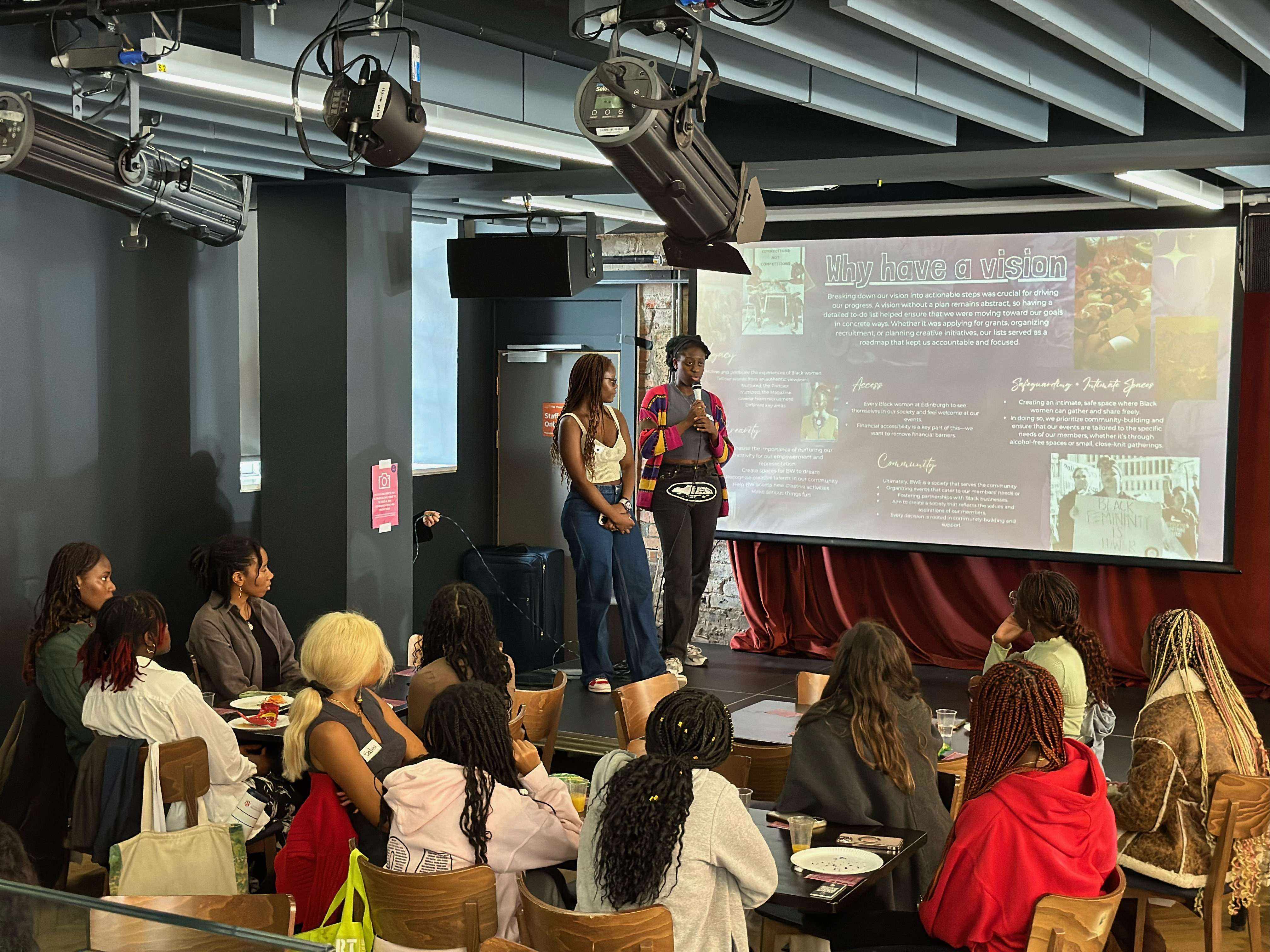
Rutendo and Claudia, President and Vice President of Black Women* at Edinburgh presenting at our first official event as a society in September 2024.
Image credit: Katherina Alawode (2024)
Black women have long championed both anti-racist and feminist movements, yet their contributions are often erased. In recognition of Black History Month, this article explores how Black women’s organisations are reclaiming narratives through decolonial, intersectional, and African feminist frameworks, with a focus on campus activism and the importance of creating inclusive, representative spaces.
Black women have played a crucial role in both anti-racist and feminist movements, from historical figures like Sojourner Truth and Harriet Purvis to contemporary advocates such as Tarana Burke, who created the #MeToo movement in 2006 to combat sexual violence against young Black girls. Although Alyssa Milano popularised the hashtag in 2017, she failed to credit Burke. In response, Burke expressed difficulty with coping with this erasure, which is rooted in class and race bias.
On campus, Black women have been advocating for more inclusive curricula, the hiring of Black academics, and enhanced support for Black students amid rising anti-Black racism. In response to the #BlackLivesMatter movement, we have pushed for courses that address Black identity, but many Black students report being negatively affected by blind course allocation processes that limit our opportunities to study our intersectional identities.
This raises questions about what Black feminist liberation looks like on campus. Liberation that speaks to our lived experience can be encapsulated by four key themes: agency, representation, recognition, and consideration. So, what links the struggles of Black feminists in history with the experiences of Black women students in PWIs today? Black women frequently face microaggressions and are often perceived as angry when voicing concerns, while also being tokenised as experts in intersectionality when discussions of race and gender arise in the classroom. Accordingly, it is essential for our peers to practise empathy and engage in allyship by increasing their understanding of these issues.
From the Women’s Suffrage Movement to contemporary anti-racist campaigns and within university environments, our achievements remain largely unrecognised. Simultaneously, Black women experience unique microaggressions that differ from those highlighted in mainstream feminism, a reality described as hyper-(in)visibility. This term captures how marginalised identities are both excessively scrutinised and systematically erased, particularly in institutional and interpersonal contexts.
At the university, feminist and women’s societies often emphasise diversity, yet Black women remain underrepresented in both leadership and membership. The common question arises: if representation is desired, why not simply join these societies? Speaking for ourselves can provide white-majority societies with insight into our experiences, but it does not guarantee that they will become good allies or recognise the importance of intersectional identities, particularly the intersection of race and gender. When setting agendas, individuals who identify with a particular group typically prioritise that group's issues, often sidelining the unique challenges faced by Black women.
While white feminists may understand sexism and misogyny, they often struggle with allyship toward Black women, particularly regarding the intersection of misogyny and racism, leading to the term “misogynoir.” Reverend Dr. Pauli Murray, being the only female student at Howard University Law School, coined the term "Jane Crow" to describe the dual oppression of Black women, influencing the inclusion of sex-based discrimination in the Equal Protection Clause. Unfortunately, much of her work remains unknown, reinforcing the concept of hyper-invisibility. For Black women, the experiences of racism and sexism are intertwined, and no aspect of identity is more significant than the other. This intersectionality, as Kimberlé Crenshaw describes, is critical to understanding our lived realities.
Liberal feminism has faced criticism for its “add women and stir” approach, suggesting that gender equality can be universally achieved by removing legal barriers for women. This framework often homogenises the experiences of women of colour, erasing their struggles and amplifying those of white women, a clear manifestation of white privilege. Therefore, it is insufficient to simply “add Black women” to feminist discourse. White feminists must actively confront and dismantle racism, including microaggressions, within their own lives and the operations of feminist societies. Feminism must be an anti-racist movement.
As such, Black feminists, like Hazel Carby, assert that racism must be acknowledged in relationships with white women, while bell hooks emphasises that the feminist movement could be more impactful by revealing how racism and sexism are interconnected rather than dismissing racism altogether. For feminism to be truly intersectional, it must translate into concrete actions beyond declarations, particularly throughout Black History Month.
In this context, many Black women establish their own spaces focused on (Black) sisterhood. In the 1970s and 1980s, sisterhood became pivotal in internationalist feminisms, emphasising collective care while recognising differences. Hooks envisioned a sisterhood that addressed intersections of gender, class, and race, unlike the white racist sisterhood critiqued by Carby, who highlighted that “the herstory of Black women is interwoven with that of white women, but this does not mean that they are the same story.”
The impetus for Black Women* at Edinburgh is the concept of sisterhood, highlighted by various Black feminist authors as integral to our lived experiences. Our society empowers Black women and those identifying with Black femininity—women of African, African Diaspora, and Caribbean descent—through mentorship and personal development. Our activism is practical. We believe in providing Black women* students with access to spaces where they would not normally feel comfortable or welcome, by curating events led by us, with the intention to cater for the health and wellbeing of Black women. A space that disallows all forms of racism, and especially the microaggressions that majorly affect Black women specifically.
Black Women* at Edinburgh is an organisation born out of necessity to provide space for Black women to not only exist but thrive. We are not the first society of our kind in the UK; we draw inspiration from historical organisations like the Brixton Black Women’s Group and Maud Sulter and Ingrid Pollard’s Black Women's Creativity Project in Scotland, which laid the foundation for solidarity, friendship, and activism. We honour the contributions of Black feminist leaders who established similar societies at Warwick, Cambridge, Leeds, and Manchester. At Edinburgh, Black women students understand sisterhood as building a community where they have agency, and feel represented, recognised and considered.
Thus, my challenge to feminist student groups in a PWI is, within and outside of Black History Month: are you actively engaging with intersectionality? Are you advocating for the representation, recognition, and consideration of Black women’s voices in your communities?
References
Arshad, R. (2019). Thematic Review 2018-19: Black and Minority Ethnic Students Final Report Foreword from the Review Convenor. [online] Available at: https://www.ed.ac.uk/files/atoms/files/thematicreview2018-19-bme-students-finalreport.pdf.
Assad Abderemane (2021). How Hazel Carby Called Out White Feminists’ Racist Sisterhood | Medium. [online] Medium. Available at: https://assadabderemane.medium.com/how-hazel-carby-called-out-white-feminists-racist-sisterhood-in-the-80s-7fb359b6c280 [Accessed 3 Oct. 2024].
BlackEd Movement (2020). BlackED Movement | LinkedIn. [online] Linkedin.com. Available at: https://www.linkedin.com/company/blacked-movement/?originalSubdomain=uk.
Crenshaw, K. (1989). Demarginalizing the Intersection of Race and Sex: a Black Feminist Critique of Antidiscrimination Doctrine, Feminist Theory and Antiracist Politics. University of Chicago Legal Forum, [online] 1989(1), pp.139–167. Available at: https://chicagounbound.uchicago.edu/cgi/viewcontent.cgi?article=1052&context=uclf.
Dadzie, S. (n.d.). The Black Women’s Movement. [online] Google Arts & Culture. Available at: https://artsandculture.google.com/story/the-black-women-s-movement-black-cultural-archives/hAUBVgWeiBZ-Ig?hl=en.
hooks, bell (2024). Sisterhood: Political Solidarity between Women on JSTOR. [online] Jstor.org. Available at: https://www.jstor.org/stable/pdf/1394725.pdf?refreqid=fastly-default%3Ad23e8b649a74d0d0bbe473b89d5ab9d5&ab_segments=&initiator=&acceptTC=1 [Accessed 3 Oct. 2024].
Mirza, H.S. (1982). White woman listen! Black feminism and the boundaries of sisterhood*. In: Black British Feminism. [online] London and New York: Routledge, pp.45–53. Available at: https://americanstudies.yale.edu/sites/default/files/files/carby_1997_-white-women-listen.pdf.
Mitra, D. (2023). Sisterhood Is X: On Feminist Solidarity Then and Now. South Atlantic Quarterly, 122(3), pp.431–452. doi:https://doi.org/10.1215/00382876-10643959.
Murhula, C. (2022). Tarana Burke, unsung hero of #MeToo. Le Monde.fr. [online] 6 Oct. Available at: https://www.lemonde.fr/en/international/article/2022/10/06/tarana-burke-unsung-hero-of-metoo_5999292_4.html.
Nimis, É. and Pons, L. (2020). Maud Sulter. [online] AWARE Women artists / Femmes artistes. Available at: https://awarewomenartists.com/en/artiste/maud-sulter/.
Peterson, M. (2019). The Revolutionary Practice of Black Feminisms. [online] National Museum of African American History and Culture. Available at: https://nmaahc.si.edu/explore/stories/revolutionary-practice-black-feminisms.
Settles, I.H., Buchanan, N.T. and Dotson, K. (2019). Scrutinized but not recognized: (In)visibility and hypervisibility experiences of faculty of color. Journal of Vocational Behavior, 113(113), pp.62–74. doi:https://doi.org/10.1016/j.jvb.2018.06.003.
Author bio
Rutendo is a fourth-year student in the MA (Hons) International Relations and International Law programme at the University of Edinburgh. She is the founder and current President of Black Women* at Edinburgh, as well as the former President of the African and Caribbean Society. As a passionate feminist advocate and educator, Rutendo is dedicated to fostering safe, equitable, and sustainable spaces for marginalised communities. She is also the first board pioneer of Engender, Scotland's feminist policy organisation, and previously co-founded @wearenotbroads, an online platform tackling rape culture among young Zimbabweans.
Instagram: @ama.nda_h, @blackwomenatedinburgh, @nurtured.mag