
Introducing Margaret Hall's Cairn
Following sustained activism by local historian Andy Arthur and author Sara Sheridan, a cairn in Edinburgh has been renamed to reflect the woman whose life was taken near the spot . The story of Margaret Hall is one of brutal gender-based violence and sustained torture and the cairn now stands as testament to her life rather than her husband whose name the cairn initially reflected. Andy Arthur shares with us his comments from the occasion of the renaming.
(This blog contains material related to gender-based violence that could be distressing to many readers.)
We stand here in front of what might appear to be an unremarkable pile of stones, but is actually a deliberately placed memorial cairn. It publicly commemorates a woman - a child - who in her short life was the victim of appalling male violence.
Sadly over the course of time, it was the name of the abuser which became associated with the victim's memorial and entered in the official records; her name and story slowly fading from public consciousness.
Her name was Margaret Hall and she was murdered by her husband near this spot on the night of October 17th 1720. His story was well covered in sensationalist press at the time; his letters, confessions and smears were widely published and as a result become a grisly chapter in many books of old Edinburgh.

Pic: Remembering Margaret Hall, photo by Fiona Mackay
But nobody gave a voice to the victim or told her story. That’s something myself and Sara Sheridan (who sadly cannot be here today) have been trying to rectify, and telling Her story is exactly why we are standing here today. It’s also why I’ll relate it to you without using his name.
Margaret was born in Edinburgh in 1703 and her birth registration in the old parish register is the only official record of her we have been able to find. Her father kept a tavern on the Castle Hill and when she was aged 16, a feckless and profligate medical student came to lodge there with them. Margaret soon fell for his apparent charms - a minor title, an education and some inherited wealth - and despite her father's initial misgivings, marriage followed within a month.
He soon tired of his matrimonial commitment and of his young bride and sought to abandon both her and his creditors, but not without first defrauding her of her rightful aliment from him. He set on a course of fraudulent divorce, bringing a conspirator on board under formal contract.
Together they tried to convince Margaret she had been abandoned, but they failed. They fabricated an arrest warrant for her to prevent her seeking counsel with her mother-in-law, but failed. They tried to fabricate evidence against her honour and again failed.
With failure came escalation. They tried - repeatedly - to have her break her marital vows under the influence of alcohol and drugs. When that failed, they tried to do so forcibly, but again failed. Failing at every turn, they resolved on the ultimate escalation; Margaret was to be murdered.
They tried to poison her and although she suffered, they failed. Under the pretence of caring for her, the medicine they offered was laced with poison but despite immense torment and sickness, they failed. Schemes to drown her in a quarry hole, or push her from a horse or have her battered with a hammer all failed.
Resolving to bring matters to a fatal conclusion by himself, her husband stole a knife from his landlady and after a day of wining and dining himself, convinced Margaret to join him on a night time walk to Duddingston Kirk. It was on that fateful evening, at a spot near the cairn, Margaret Hall’s life was brought to a brutal end by her husband, her abuser.
The next morning she was found with “many other wounds received in her dying struggle“; she had fought to the end to defend her life. Her body was carried to the Abbey Sanctuary of Holyrood, but what became of it remains an enigma.
Her husband was found guilty and executed by hanging in the Grassmarket; his key conspirator was transported for life. Such was the magnitude of their crimes that even in a time of commonplace violence against women, and relative cheapness of life, there was an intense outpouring of public grief about her fate, and a cairn was raised in her memory.
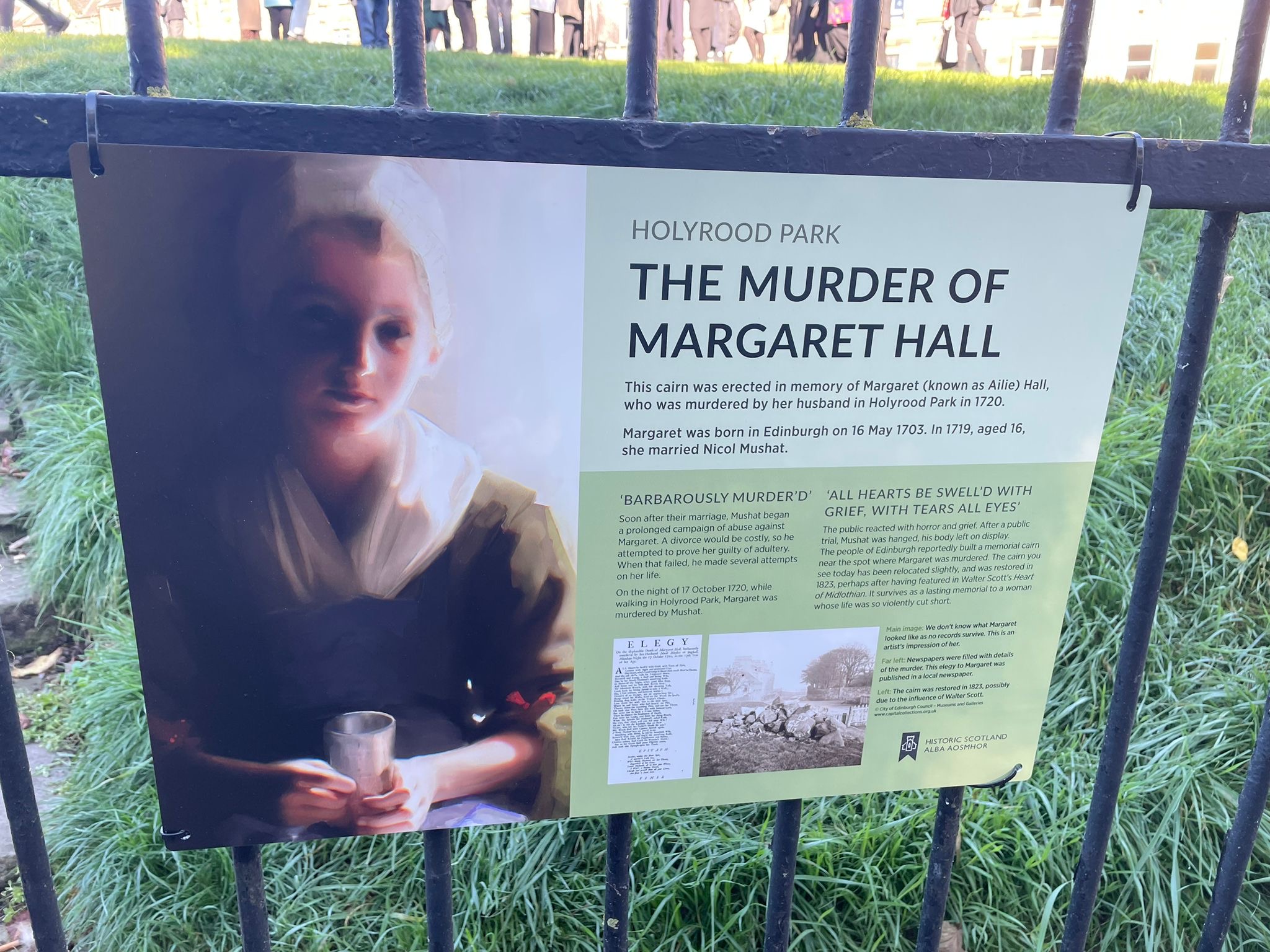
Pic: Additional details on the board for Margaret Hall, photo by Fiona Mackay
But not this cairn; that one was forgotten about and disappeared in her own century. But the long memory of Walter Scott’s pen rehabilitated it in the Heart of Midlothian and it was restored here in 1823. Unfortunately Scott also cemented his name to it. But it was -is - her cairn. With no known headstone or final resting place, it’s all she has. So I am very pleased that today we are taking another step on a journey to returning it to her as Margaret Hall’s cairn.