
3 Funerals and a Wedding? A Seventeenth-century Woman’s Reasons for Writing
This post asks what motivated a Yorkshire gentlewoman, Alice Thornton, to write four accounts of her life in the late seventeenth century. From losing her own mother to wanting to provide for her three fatherless children, Thornton’s manuscript books give us one woman’s perspective on life, death and the law.
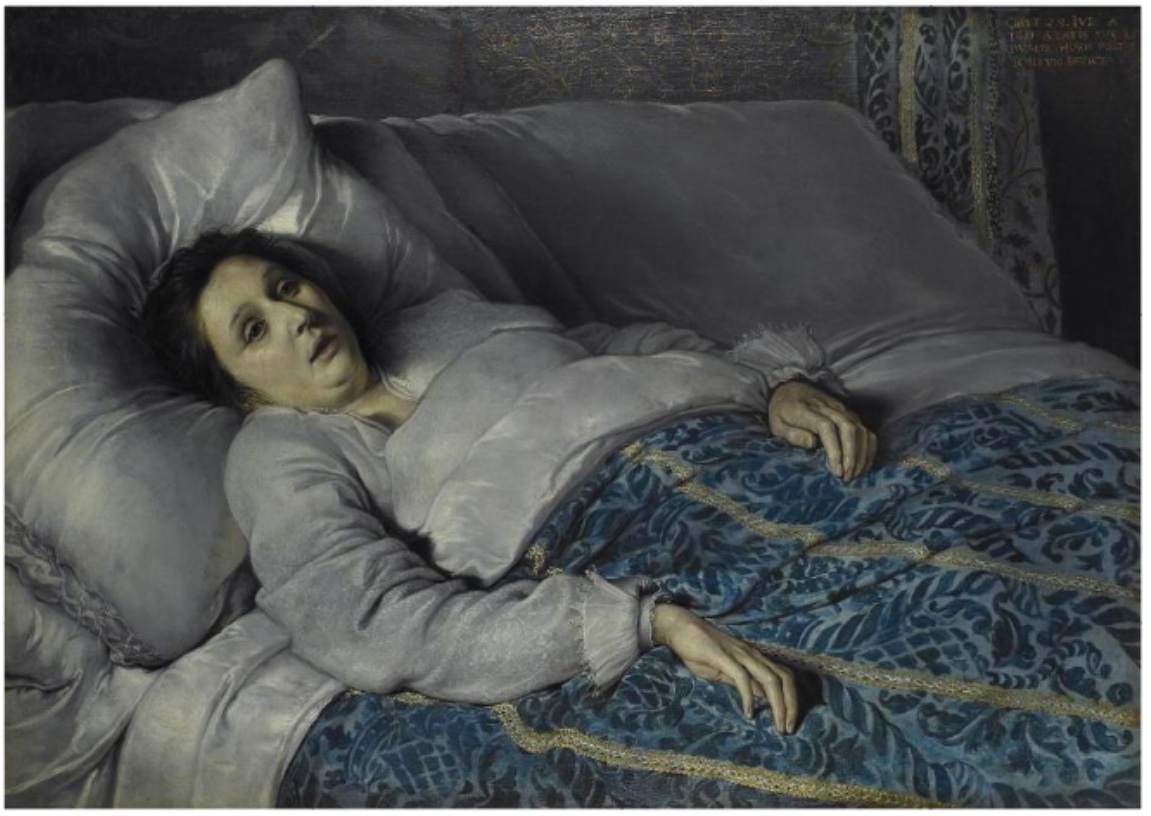
Image credit: Musée des Beaux-Arts de Rouen, via Wikimedia Commons
When Alice Thornton died in 1707, at the age of eighty, she left ‘three books … of my life’ to her oldest daughter, Nally. Our AHRC-funded project, ‘Alice Thornton’s Books: Remembrances of a Woman’s Life in the Seventeenth Century’, has recently made a digital edition of these three books and a Book of Remembrance, which survived as single manuscript copies, two only recently located. One of our research questions was to ask what motivated Thornton to write these books. We have largely been guided by internal evidence, especially that which pointed to when these books were written.
The Book of Remembrances records events in Thornton’s life from her birth in February 1626 to her husband’s death in September 1668. It is noticeable, though, that it is only with the final illness and death of her mother, Alice Wandesford, in late 1659 that Thornton starts to consistently treat events at length. This suggests that it was around 1659 when Thornton started to write in this book. As Sharon Howard, one of our postdoctoral researchers, has argued, her mother was a vital source of emotional, financial, domestic and religious support for Thornton, all of which were then in short supply after her death. The loss of her mother hit hard.
The ‘first book of my life’ (Book 1), while also a chronological account of her life from birth to her husband’s death, is a much fuller retelling of the material recorded in the ‘Book of Remembrances’. This book though was likely prompted by the events of 1668, which included her husband’s death but also events leading up to it. Rumours about Alice Thornton and the young curate, Thomas Comber, who was staying in the Thornton’s marital home, now reached the ears of the Thornton family. Her husband was sufficiently annoyed by this slander that he set out to confront one of the people responsible, a Mr Tancred, in Malton. Unfortunately, William Thornton took ill on this trip and died.
In October 1668, a month after his death, Thornton sent ‘my own Book of My Life’ to her friends and relations in Richmond, North Yorkshire, in an effort to put the rumours to bed. The description sounds more like what we call Book 1 than the Book of Remembrances. Elsewhere Thornton notes that she was still writing in Book 1 in February and March of 1669, but by then she was up to the events of late 1668, which is where she ends her account, so it is possible that she would have had nearly a full manuscript to share in late 1668.
According to Thornton, Thomas Comber was promised to her teenage daughter, Nally, in 1667, with her husband fully on board. Many felt Nally was too young (she was then thirteen), but Thornton went ahead with the marriage, in secret, in November 1668. This was likely so that Nally, the eldest child, would be provided for as William Thornton had died in debt.
While Book 3 was written a few decades later, c.1692-6, one of its main topics is the slander of 1668, against herself, her daughter and Thomas Comber. Thornton’s only son to survive childhood, Robert, died in 1692 – our third funeral - which meant that the Thornton estate of East Newton in Ryedale would now pass into the Comber line. Perhaps this was the prompt for Thornton to revisit the reasons for Nally and Thomas Comber’s marriage, amassing evidence as to those who were on her side in those months after her husband’s death.
Book 2 is perhaps the outlier. From internal evidence we have dated it to c.1685-95. In this period, Thornton lived alone as a widow. Her oldest daughter was still married to Thomas Comber, her youngest daughter had married for the first time in 1682, and her son had run up debts while a student at Cambridge and then Oxford in the 1680s. As a book it is particularly concerned with matters of property, from her father’s will which was missing for many years, to her marriage agreement which should have provided for her daughters. In this book, Thornton seems concerned to defend herself from accusations that she had not looked after the family estate well.
While the links between the other three books and a close family death seems clear, might it have been the marriage of her younger daughter, Katherine, that prompted this particular book? We know from the writings of a great-great-grandson, Thomas Comber – in a manuscript now held at the Beinecke Library, Yale - that Thornton had written another book, one which focussed on Robert’s life. According to this later Comber, that book covered events from Robert’s birth in 1662 to Katherine’s marriage to Thomas Purchas in December 1682. Perhaps Book 2 – again our title rather than Thornton’s – was motivated to look back at how she had attempted to provide for all her children, especially her daughters. The last line in the manuscript is about a deed of settlement she had got her husband to sign in 1667, ensuring that the two girls would get some property on marriage (or age 21). This marked the end of a decade’s long struggle to ensure this would be the case. On this particular struggle, Thornton wrote, ‘I have daily cause to see, there is no trust in man … and I have had great experience of man’s treachery’ (Book 2, 260).
The manuscript books of Yorkshire gentlewoman, Alice Thornton, give a vivid insight into one woman’s life in seventeenth-century England and how she used her writings both to deal with her own feelings of loss and to mount a defence of her reputation and actions both in the present and for posterity. We hope that you will enjoy reading them via our new digital edition.
Author bio:
Cordelia Beattie is Professor of Women’s and Gender History at the University of Edinburgh. From September 2021 to February 2025 she was the Principal Investigator on an AHRC-funded project, ‘Alice Thornton’s Books: Remembrances of a Woman’s Life in the Seventeenth Century’.
Social media:
Bluesky @cordeliabeattie.bsky.social and @thorntonsbooks.bsky.social
Instagram @thornton_books
Facebook Alice Thornton's Books