
Visioning Healthy More-than-Human Cities
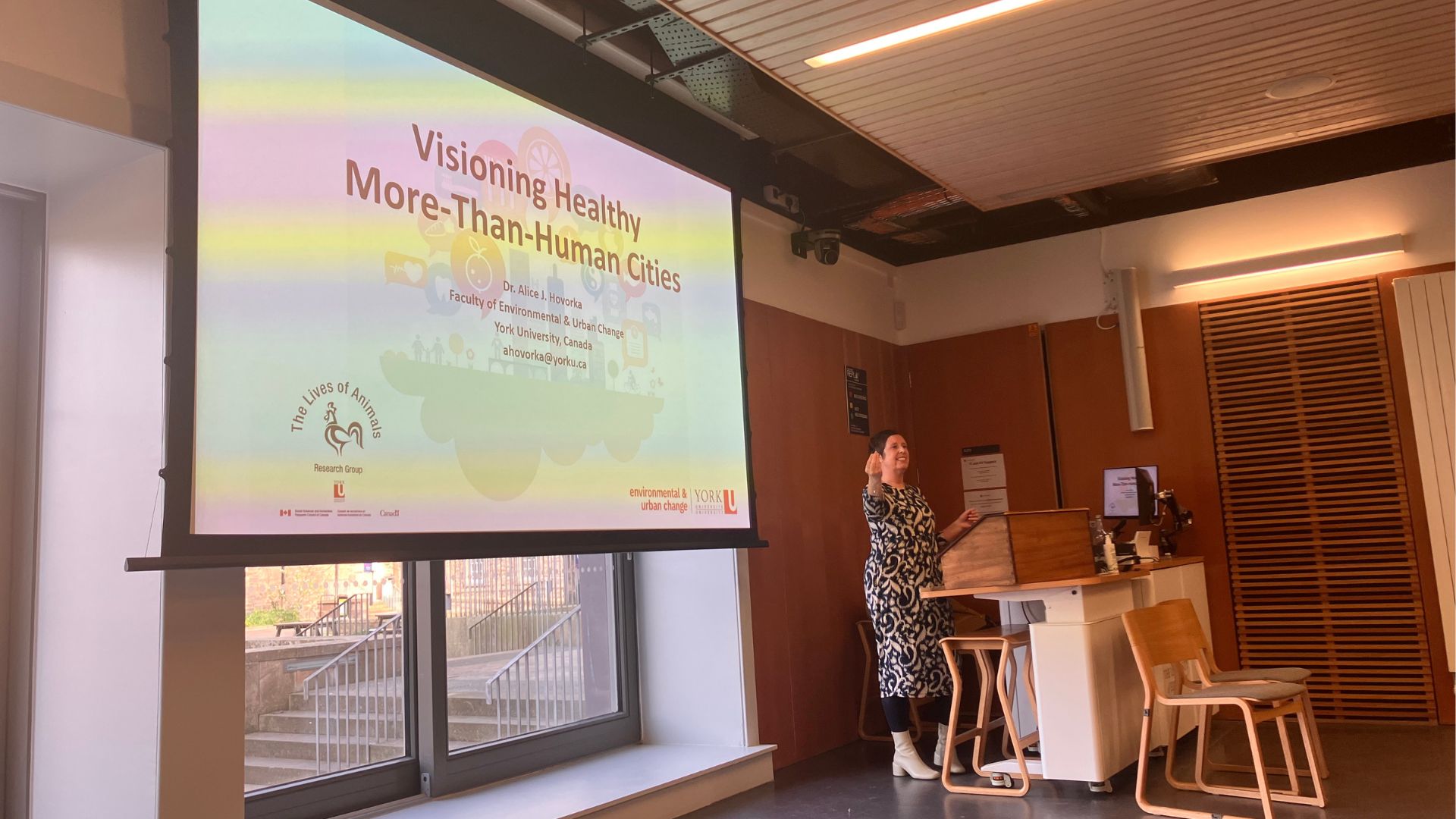
Earlier this month, Dr Alice Hovorka from York University in Canada gave a lecture on visioning healthy more-than-human cities. Feminist posthumanist conceptual frames help to articulate these possibilities. GENDER.ED’s intern, Mouna Chatt, looks back at the lecture.
What is a ‘more than human’ city?
To start the lecture, Alice began by setting the scene, outlining how cities are more than human. For instance, in cities, humans are surrounded by animals, ecological processes, energy flows, habitats for flora, and fauna. Cities draw together all these non-human actors that interact with humans to shape everyday and urban life.
Alice highlighted that the concept of ‘more than human’ cities is something that has especially taken hold the last 10-15 years. The idea brought out a focus on technology and infrastructure in the city as well as how the city is experienced and mediated by urban actors. Thus, ‘more than human cities’ brings to fore questions surrounding surveillance technologies, infrastructure, phones, railroads, bridges, and the like. In general, the ‘approach’ features a focus on technology and infrastructure and how these shape ‘the haves and have nots’ of the city.
However, ‘more than human’ cities also focus on plants and animals and looks at them as un/desired and un/valued. Though this work sees non-human actors like urban parks, pets, and other animals as having purposes and impacts for humans, we note that while some non-human actors are intentionally placed in the urban space by humans, others are there unintentionally and transgress human urban planning, such as racoons, bed bugs, and rats.
Lived experiences of non-human actors:
After outlining the theory, Alice presented some of her own research. During her doctoral research, she was looking at urban agriculture. Urban agriculture includes all forms of food production that occur in urban and/or peri-urban areas. This category ranges from survival strategies for low-income people, to middle-income ventures. Importantly, Alice showed that urban agriculture is often undertaken by women, for whom it can serve as a form of empowerment and economic liberation. While she started off with urban agriculture, she became interested in how livestock plays a role in peoples’ everyday lives in urban spaces in Botswana, and ended up writing her thesis on gender and the poultry industry. She found that poultry was often raised by lower-income women and entrepreneurial women.
Upon returning to the cities in Botswana in which she had conducted research, she realized that if the chickens had not been in the city, the infrastructure would be entirely different, and the women would not have been able to empower themselves in the way that they did. Yet, she also realized that she had only thought of the chickens as objects – not as agents with subjectivity.
Drawing on multispecies urban theory, Alice asked: What would happen if I re-worked my thesis using chickens as a social group? Multispecies urban theory recognises non-human actors as social groups with agency and power in the city. In essence, Alice thought, if the chickens weren’t who they were, men and women wouldn’t be able to do what they did in the city.
Alice highlighted how cattle had been the most important and valued animal in Gaborone until chickens found their way into the city. For this reason, chickens initially had less ‘clout’ in the urban space. However, as chickens are adaptable to a city lifestyle (they are small, grow quickly, don’t need that much space), it meant that people were able to keep their agrarian lifestyle in the city and become entrepreneurs. Urban planning began to be affected by poultry farming, with the government giving loans to people who engage in the poultry sector. The chickens began shaping the health and wellbeing of people and themselves also became central.
Performativity: the shaping of particular kinds of animals
How do we look at the experiences of animals in cities? How do we measure their welfare and how they are situated in the place? Alice highlighted that when an animal is in a city, it becomes a particular animal, i.e., it behaves in a certain way. Therefore, it is important to look at the individual animal and its’ experiences, and question why it experiences what it does.
To flesh out these questions, Alice showed how the lived experience of donkeys in Maun, Botswana was characterized by hard work, invisibility, and poor physical and emotional welfare. While they are highly valuable animals and intensively used, they received limited care by their households. They are also poorly valued beyond their households and assumed to be marginal and backwards. Alice observed the donkeys to be stoic and silent during they day, yet they are also highly social animals that interact a lot. There were so many donkeys in Maun that they often became unremarkable parts of the scenery, with people not acknowledging them. While cattle were treated very well, donkeys were undervalued and treated very badly.
Welfare assessments on the donkeys showed that they had compromised physical and emotional welfare: they were covered in sores and scars, sad, unresponsive, disinterested, stiff neck, and tense ears that pointed to the sides and back. Donkeys’ lived experiences were then characterized by a degree of suffering in the urban space. Alice also interviewed owners of the donkeys she had conducted welfare assessments on, and found that those who lived in the most dire conditions had the saddest-seeming donkeys. Thus, she concluded, “if your donkey is healthy, you’re healthy”. As the poorest needed their donkeys the most, these animals were the most overworked and put in the worst conditions. To think about how urban animals come to be shaped as particular kinds of animals, Alice turned to feminist theories of performativity.
One Health:
Alice concluded her lecture by connecting to the concept of One Health, which shows how animal health is connected to human health. For instance, if the health of a donkey is compromised and they are no longer able to work, they can no longer provide for the family and aid with their wellbeing. It is a multisectoral approach to health that requires interdisciplinarity. For instance, to understand the more than human in the city, social scientists, urban ecologists, and animal welfare people need to collaborate to work together to understand all layers of ‘health’. Health is here defined contextually and variably meaning that it needs to be tied to empowerment, justice, liveability, and sustainability – not just physical and mental health. Ultimately however, Alice wanted not only to nuance and localize the meanings of health, but also to draw One Health into conversation with feminist posthumanist orientations.