
Book Forum: Rahul Rao on Hemangini Gupta's Experimental Times
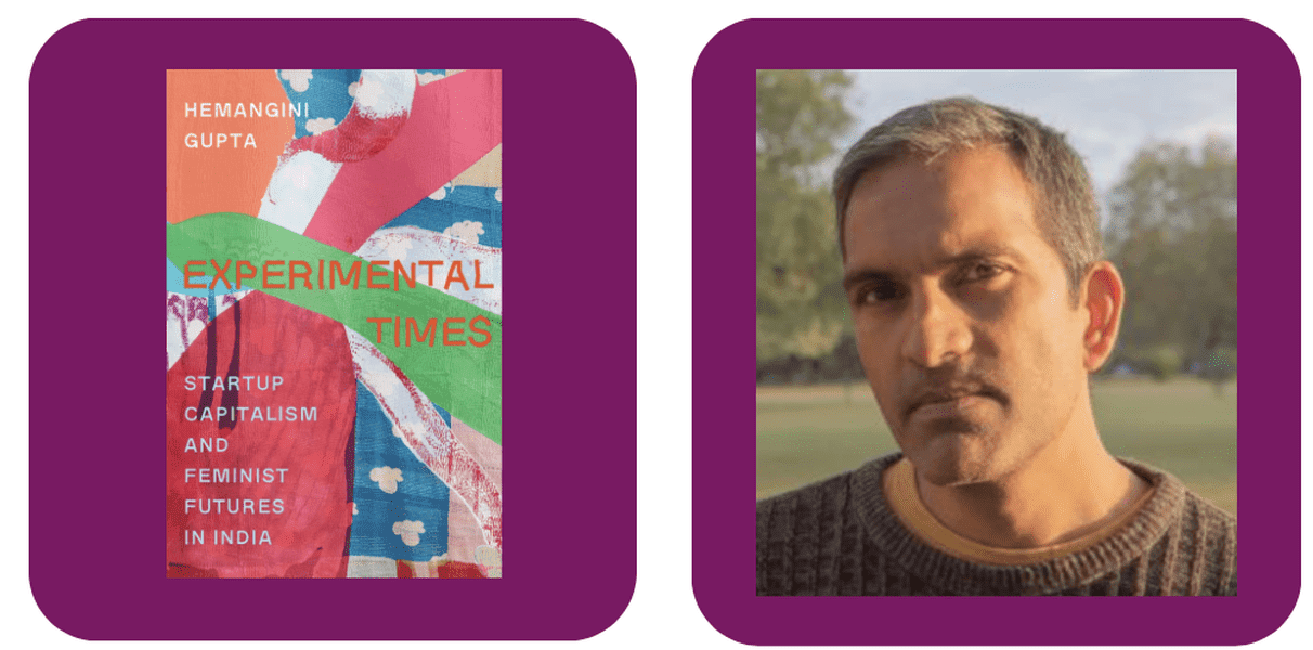
Reading Hemangini Gupta’s book Experimental Times: Startup Capitalism and Feminist Futures interpellated me in multiple capacities – as a theorist of gender, sexuality, race and caste, and as a Bangalorean who frequently returns to a city that has changed beyond recognition in my lifetime. The book investigates what Hemangini calls zones of ‘experimental time’, which she reads as simultaneously productive for the fabrication of global startup capitalism in Bengaluru/Bangalore but also for feminist future making. These processes are premised on the feminized labour of precarious and racialized workers – we see how workers experiment with new systems of work and technology, only to be depleted or rendered obsolete by these same systems. Along the way, Hemangini illuminates the racialization and caste-coding of work: desirable work is mental and creative, undesirable work repetitive and menial; both are distributed in ways that entrench stratifications of caste and class.
The book is notable for its attention to place, to the ‘ecosystem’ of startup entrepreneurship – including the figure of the entrepreneur and the ways in which caste, class and gender capital are reproduced through them. Yet Hemangini shows us how neoliberal startup capitalism produces not only an individualized entrepreneurial subjectivity but also new spaces of care replete with friendship, leisure, class mobility, and freedom from the heteronormative expectations of domestic life, that are essential for surviving and thriving in this environment. As she says, ‘While startup capitalism is often associated with the production of the individual subject, I found that it also queered the idea of the “family” and offered work as a practice of world making that transcends the self’ (p.32).
One of the most attractive qualities of the book lies in its determination to move beyond singular lenses and theoretical frameworks. Where a doctrinaire Marxist framework might have read a number of discourses and practices simply through the lens of surplus labour extraction and the crafting of more docile worker subjectivities, Hemangini insists on showing us what else is underway. Analogously, observing the celebration of a religious festival in the workplace, Hemangini reads this not simply as a practice that makes the space ‘Hindu’, but also as a site for the performance of gender and womanhood in a mode that is adjacent to, but not quite, the respectable femininity expected by natal family. The book’s analysis is always intersectional, but more than this, the ethnographic stories it tells are always richer than the available theoretical scaffoldings through which we might try to make sense of them, necessitating a revisioning of those scaffoldings.
One important conceptual revisioning that the book undertakes is in our understanding of social reproduction – particularly the range of spaces and processes through which it takes place and the way in which it is queered by being taken up outside the realm of the heteronormative family. Labour power, Hemangini shows us, is regenerated outside the heterosexual household through forms of care and kinship that are forged at, after and around work – through dance, music, sex, and nights out with colleagues at bars and pubs. This is a potentially rich and fruitful move, but also an intellectually challenging one – not least because the distinction between the labour of production and the labour of social reproduction becomes difficult to sustain when the worker’s self is itself the commodity, as is frequently the case within the ‘ecosystem’ of startup capitalism. Hemangini addresses this by pioneering what she calls ‘labour as method’, arguing that we cannot know in advance what labour is and inviting us instead to name and follow as labour a set of apparently discrete practices that become interrelated through their creation of value. Labour thus becomes indeterminate, exceeding the boundaries of the workplace and of the workday as conventionally imagined. It is productive as much as reproductive, technical as much as affective, formal and informal. The reconceptualization of labour by startup capitalism has potentially profound implications for organising and welfare in the workplace, challenging as it does the foundational premises of trade unionism and collective bargaining.
The book pays equal attention to the dynamics of entrepreneurial subjectivity, offering fascinating glimpses into the pedagogy of entrepreneurship and the processes by which proto-entrepreneurs are more fully interpellated into their future possible selves. Here it becomes clear that the mores shaping entrepreneurial knowledge production emanate as much from stories of successful startups in (the original) Silicon Valley as from indigenous norms around caste and labour, nationalistic and self-aggrandising narratives about the supposed benefits of yoga, etc. Cultivating an appetite for risk – the apparent sine qua non of the entrepreneur – entails producing a subject who is freed from caste and gendered norms by being disembedded from and unencumbered by ‘traditional’ obligations, but who is somehow still able to accrue the benefits of caste and gender privilege.
This seems harder for women – even class- and caste-privileged ones – given their reduced mobility in space and access to time as a result of non-negotiable family obligations. As such, startup capitalism remains a domain that privileges men, emerging as a sort of phallic exchange between groups of men (investors and startup founders), thereby challenging the self-representation of the industry as driven by merit, risk-taking and passion. Hemangini shows how when women pitch ideas that emerge from their gendered life experience, these are read as examples of reproductive labour oriented towards care work. Because the potential success of startups is measured in their scalability and reach and because a great deal of care work is not scalable, these innovations are considered entrepreneurial but not as ripe with startup potential: they are not valued as ideas that can be technologized into an app and scaled up. The ‘failures’ of startup women entrepreneurs are a record of the ways in which women’s work remains naturalized and relegated to the uncompensated realm of the household. This feels like a very old problem in a new domain, in which the limits to the scalability of social reproduction make it less amenable to being recognised as valuable work in the startup economy.
Hemangini elucidates the affective dimensions of ‘experimental time’ most clearly when she describes the workplace culture of the elite travel startup in which she embeds herself for the duration of her fieldwork. Here, ‘do what you love’ seems to be an enduring refrain of managerial culture, encouraging workers to perform love and happiness as a means of increasing customer satisfaction and thereby profit. In this form of what she calls ‘authenticity work’, the product is the employee’s ‘responsive, caring, connected self’, which is produced not only through productive labour but also through the visible performance of leisure pursuits by the worker (notions of ‘work-life balance’ are rendered quaint when work and fun/life become indistinguishable).
Employees might collectively buy into the mantra of ‘work as family’, yet Hemangini’s skill and sensitivity as an ethnographer illuminates the range of meanings that this can take on. Thus, her more elite interlocutors seem to speak of the company as a family in abstract, metaphorical terms, as an imagined rather than a face-to-face community. For less elite staff, the company family is more tangible and visceral: it is what fills gaps in infrastructures of care, providing rides home from work when public transport breaks down or is otherwise unavailable for example (as a Bangalorean, I appreciated the book’s attention to the city’s much deplored frictions of transport and travel). Hemangini shows us how workers, especially in back-office roles, translated the imperative to ‘do what you love’ into desirable forms of experimentation and consumption that were personally pleasureable and sociable. Leisure spaces became performative spaces of claiming class belonging and knowing, creating new class identities even if only fleetingly (‘middle class futures were being tested’). Unconventional ideas of family and care are forged and performed in these spaces. Infrastructures of care emerge in this account as not merely extractive, but also regenerative. Perhaps, in a more cruelly optimistic vein, they are able to be more extractive than they otherwise might have been precisely because they also feel regenerative.
It is in the nature of experiments that they sometimes fail. The book narrates many instances of failure, although Hemangini sometimes refuses the word: discussing the experiences of women entrepreneurs who do not secure funding for their ventures, she says ‘I understand these not as failures but as the irreconcilability of heterosexual time and entrepreneurial time’ (p.251). Still, other parts of the book seem to narrate what seems very much like failure. The account of automation in the office, for example, reads like a bad romance – a story that begins with the seduction of improvements in technology but that ends with once enthusiastic workers becoming redundant. How do workers in startup capitalism make sense of failure? Is it accepted as a ‘natural’ concomitant of risk? As a means of acquiring necessary resilience? As a sign that one is not cut out for startup capitalism? And even if things don’t work out, is the experiment of inhabiting new middle-class modes of leisure and compensation, however temporarily, a kind of compensation for failure? Or evidence of success, even if the supply of work and income proves to be precarious and unreliable? Here the very categories of success and failure seem to break down, immersing the subject in the endless uncertainty of experimental times.
Dr Rahul Rao is a Reader in International Political Thought at the University of St Andrews. His research interests include international relations, postcolonial and queer theory and the politics of South Asia.