
The Houses Fiona Built
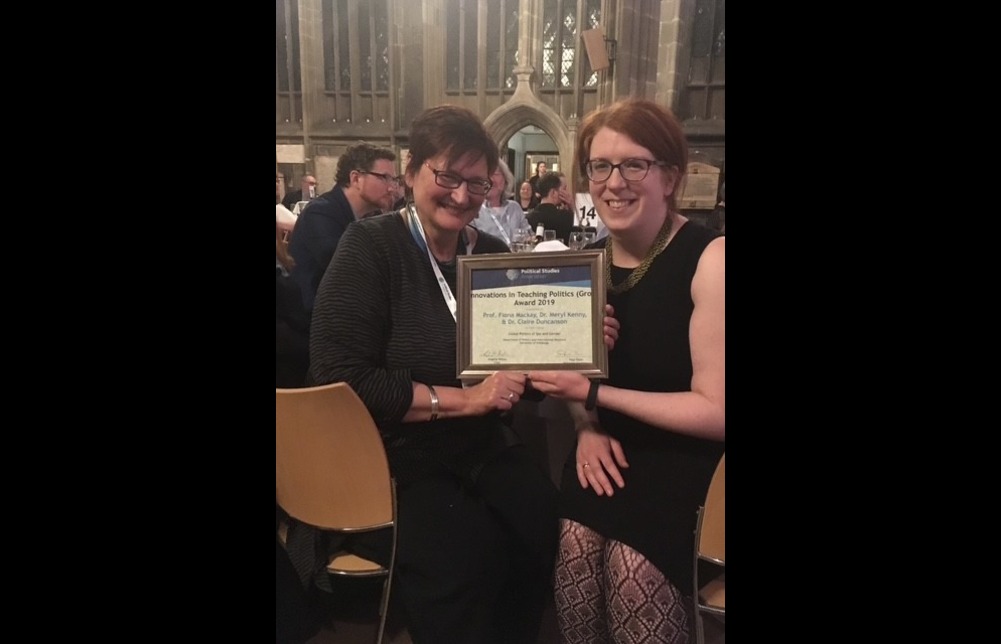
Fiona Mackay and Meryl Kenny winning an Innovation in Teaching Politics award from the Political Studies Association in 2019. Photo from Meryl Kenny
Continuing our dossier of blogs one year on from Fiona Mackay's retirement, Meryl Kenny canvasses Fiona's homes: how frequently Fiona opened her own doors to colleagues for feminist mentoring and the feminist bricks and memory she has left at the University.
I met Fiona 23 years ago whilst working as an intern at the new Scottish Parliament during my undergraduate year abroad from America and was immediately inspired by her. Fiona’s anthology on women in contemporary Scottish politics influenced my undergraduate dissertation on the power of women’s political representation, and in 2004, I came back to Edinburgh and was lucky enough to be her PhD student! Since then, I have had the pleasure of being her colleague and co-author, and it feels like a full circle to have become Head of Politics and International Relations at the moment of her retirement.
Fiona has done so many big things throughout her career, but this should not overshadow the small things that she has done which have also had large, resounding impacts. She set up the SPS choir and campaigned for our SPS building to be named the Chrystal Macmillan Building, after the first woman to graduate in science at the University of Edinburgh. She also fostered a community space for staff within the school through the CMB café, which unfortunately closed in 2025 due to budget cuts at the university. She also encouraged a further sense of community by making the case for the Politics and International Relations welcome dinner where new students can meet PIR staff. It runs at the beginning of each academic year and has been incredibly important for students’ experience in the department.
On top of this, Fiona’s generosity is evident in the number of times she has welcomed colleagues into her home. Her kitchen table is a place where countless PhD students were hosted, where many PIR women’s dinners took place, and a wide range of lecturers received advice on their promotion applications, perhaps encountering Fiona's supposedly encouraging resting neutral face in the process.
As a feminist hoping to deliver change in challenging times, I ask myself multiple times a day: “what would Fiona do?”. Her informal mentoring, support and advice have continued long beyond official job descriptions. The gap she leaves behind in this area is immense.
Sara Ahmed writes that feminist bricks and memory form the material through which we build our intellectual and political dwellings. These dwellings do not just exist out in the world but have to be brought to life through everyday practices. The house that Fiona has built stands very strong, and there is a “Mackayan” ethos in all of us; whether that is through working across boundaries, building bridges, creating more inclusive institutional cultures or using institutional power equitably and progressively.
She has enabled us to build new connections, develop new networks and raise pressing and important questions around the future of feminist leadership.