
Small acts, fundamental transformations: Fiona Mackay
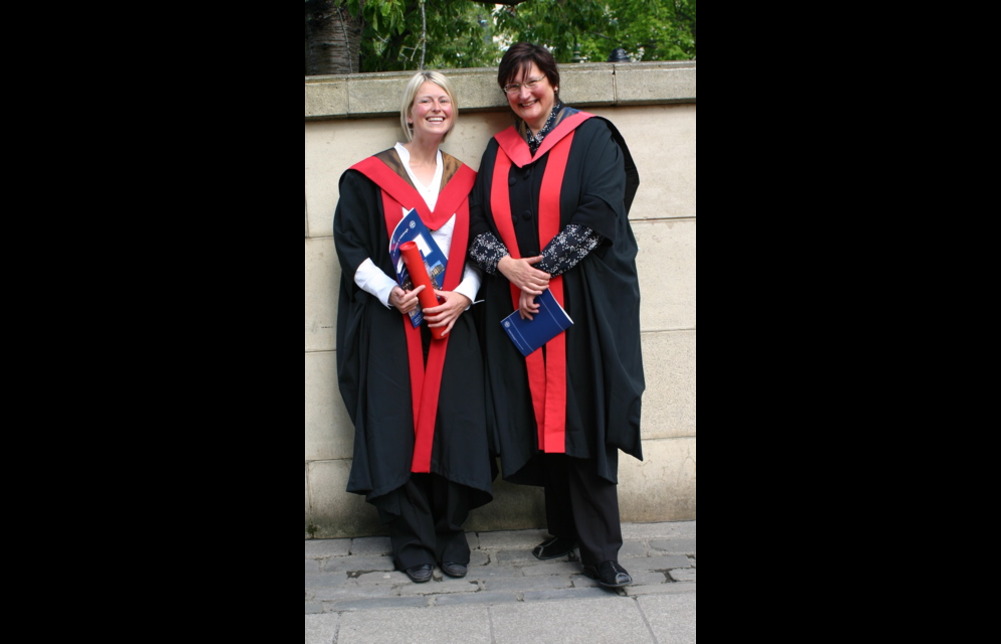
Claire Duncanson’s PhD Graduation, April 2008. Photo by Claire Duncanson
Continuing our dossier about GENDER.ED founder Fiona Mackay's retirement, Claire Duncanson analyses instances of Fiona's wisdom, leadership and kindness as formative feminist practices of care.
Fiona was my supervisor when I arrived here to embark on my PhD research in September 2002, so we have had a long professional and personal relationship and I’m delighted to say a few words to celebrate her career (and mourn her retirement).
I was doing my PhD research on military masculinities – whether there might be any signs of progress in the way soldiers were constructing their masculine identities in relation to peacekeeping roles that many were tasked with doing in the Balkans in the 90s. Fiona, meanwhile, was researching women’s representation in institutions (from the Scottish Parliament to UN women) – whether there was potential there, in ideas of ‘thick conceptualisations of substantive representation’, for bringing about gender equality and justice. Both of us loved a 1981 paper by feminist sociologist Cynthia Cockburn (RIP) called “Equal Opportunities: the long and short agenda”, which showed really clearly how small steps that might seem limited reforms can add up to transformational change - change which really challenges the structures that are driving gendered insecurities, inequalities and injustices, the intertwining structures of patriarchy, racism, colonialism, militarism and capitalism.
It struck me that Fiona’s role as supervisor, mentor, colleague and friend shares something of that idea: that relatively small acts can bring about a more fundamental transformation.
Fiona carried out so many small acts of wisdom, leadership and kindness that have actually transformed who I am as an academic, and a person, and indeed, what it means to be an academic. Some of these reflections might resonate with other supervisees, mentees and colleagues.
There are too many to list, but I will share just three:
1) I started my PhD part-time, dividing my time between my doctoral research and working for Amnesty International. I thought I had the dream mix of academia – researching the causes of insecurity and injustice – and actually making a difference in the world – contributing to tackling insecurity and injustices. Actually, however, I was spread too thin and doing them both badly. Fiona steered me through that dilemma, helped me make the decision to transfer to full-time academia, counselling that academic work is also, or can be, a form of activism, a way of making the world a less unjust place.
2) Also during my PhD, Fiona gave me opportunities not just to tutor on courses she taught, but to really collaborate on teaching and marking. She practiced a particular compassionate and empowering mode of teaching that was focused on equipping graduates with the knowledge and skills to make a difference in the world, to work for a fairer, more equal world. Fiona’s efforts to involve me as a collaborator didn’t just develop my teaching skills and experience, but also fostered and modelled an expansive, transformative vision of what university education can mean and do. This is an approach which, due to its relatively labour-intensive nature, is under threat in the wake of the current cuts, but Fiona’s practice was inspirational and one which we need to defend.
3) There were so many acts of personal kindness, but one I’ll mention– my parents found themselves living in Fife during covid, quite near Fiona and Georgie, and at the same time my mum was diagnosed with Alzheimer’s. It became pretty clear they were not coping. On quite a few occasions where disaster struck, Fiona went above and beyond in coming to the rescue when it was impossible for me. That’s just one of multiple small acts of kindness she managed to squeeze into her role as mentor, friend and colleague. These sorts of things are the mark of a good friend, but they also give me faith I’m not wrong when, in teaching and research, I make the fundamental feminist point that humans practice care, compassion and cooperation as much as competition and self-interest, that we are fundamentally interdependent, not independent, with all that that insight means for our capacity to rethink the political and economic systems that are driving inequalities, insecurities and ecological collapse.
Fiona has demonstrated throughout her career that you can practice and build institutions around care, compassion, collegiality and cooperation, in ways that model the transformations we need not just in the academy but in the world.
My god I miss her…
Author biog:
Claire Duncanson is Professor of Global Politics at the School of Social and Political Science.